
DOT Compliance Checklist for Trucking Companies
Whether you run one truck or ten, DOT compliance is the same set of plates to keep spinning. Miss one deadline and you risk fines, an out-of-service order, or losing your authority. Here's every item to track — driver, vehicle, federal, and state — plus what belongs in your compliance binder.
Last updated: 10 min readBy OverTheRoad.AI Team
Compliance deadlines at a glance
| MCS-150 update | Every 2 years (biennial), or whenever company info changes |
|---|---|
| DOT medical card | Up to 2 years (1 year for certain conditions) |
| Annual DOT inspection (Periodic) | Every 12 months per vehicle |
| Form 2290 (HVUT) | Annual, due August 31 |
| UCR registration | Annual, runs Jan 1 - Dec 31. About $46 for 0-2 vehicles (fee set each year) |
| IFTA returns | Quarterly: April 30, July 31, October 31, January 31 |
| IRP apportioned registration | Annual, base-state expiration date |
| Drug & alcohol consortium | Continuous enrollment; random testing year-round |
| Driver MVR review | Annual |
Driver Compliance
- CDL (Commercial Driver's License): Valid and correct class. Renewal dates vary by state (typically every 4-8 years). Driving with an expired CDL is an instant out-of-service order.
- Medical card (DOT physical): Required every 2 years. Some conditions (diabetes, high blood pressure) require annual renewal. Without a valid medical card, your CDL is downgraded.
- Drug & alcohol testing: Pre-employment, random, post-accident, and reasonable suspicion. Must be enrolled in a DOT-compliant consortium. A missed or refused test is treated as a refusal, which carries the same consequences as a positive.
- MVR (Motor Vehicle Record): Annual review required for every driver in your fleet.
- PSP (Pre-Employment Screening): Check crash and inspection history before hiring any driver.
- Hazmat endorsement: If applicable. TSA background check required, renewal every 5 years.
Pro Tip
Set reminders for 60, 30, and 7 days before your medical card expires. Most owner-operators don't realize their CDL gets automatically downgraded if the medical card lapses — even if the CDL itself is still valid.
Vehicle Compliance
- Annual DOT inspection: Every 12 months. Must have current sticker displayed. An expired sticker is a guaranteed inspection and potential out-of-service order.
- Vehicle registration (IRP): Annual renewal through your base state. Operating with expired registration can result in impoundment.
- DVIR (Driver Vehicle Inspection Report): Pre-trip and post-trip inspection reports. Required daily by FMCSA regulations.
- Brake adjustments & tire condition: Must meet FMCSA standards at all times. Brake violations are the #1 reason trucks get placed out of service.
- ELD compliance: Device must be FMCSA-registered and functioning. ELD malfunctions must be reported and resolved within 8 days.
Business & Authority Compliance
- MC/DOT authority: Must remain active. Insurance lapses trigger automatic revocation — and reactivation takes weeks.
- Insurance: Liability minimums are $750K for general freight, and higher ($1M+) for hazmat or passenger operations; cargo coverage and FMCSA filings must also stay current. A lapse of even one day can revoke your authority.
- BOC-3: Process agent designation. Must be on file. Usually set once and forgotten, but verify it's still active.
- UCR (Unified Carrier Registration): Annual renewal. About $46 for 0-2 vehicles (fee is set each year).
- Form 2290 (HVUT): Annual. Due by August 31. $550 for trucks at 75,000 lbs GVW.
- MCS-150 update: Biennial (every 2 years based on your USDOT number). Failure to update can lead to USDOT deactivation.
- IFTA license & decals: Annual renewal through base state. Quarterly filing required.
Recordkeeping Requirements
- Driver qualification files: Must maintain for every driver, kept for 3 years after employment ends.
- ELD/HOS records: Retained for 6 months. Must be available for inspection at roadside.
- Drug testing records: 5 years for positive results, 1 year for negative results.
- Vehicle maintenance records: Keep for at least 1 year plus 6 months after vehicle leaves service.
- Accident records: 3 years for DOT-recordable accidents.
- IFTA records: 4 years. Includes fuel receipts and mileage records.
What Non-Compliance Actually Costs
FMCSA penalties are steep and escalate fast:
| Violation | Penalty |
|---|---|
| Operating without authority | Into the five figures per violation (adjusted annually) |
| Insurance lapse | Authority revocation |
| HOS violations | Into the five figures per violation (adjusted annually) |
| Expired medical card | Out of service |
| Failed drug test (no follow-up) | Driver removal |
| Expired DOT inspection | Out of service + fine |
| Late IFTA filing | $50 or 10% of tax |
Beyond fines, out-of-service orders mean you're parked — no revenue, stranded loads, and potentially a tow bill. Compliance violations also affect your CSA score, which some brokers check before offering loads.
Frequently Asked Questions
What are the most common DOT inspection violations?
Brake issues are #1 — including out-of-adjustment brakes and air leaks. Tires (tread depth, sidewall damage) are #2. Load securement, lighting defects, and expired annual inspection stickers round out the top 5. Almost every out-of-service order traces back to one of these five categories.
How often do I need a DOT medical card?
Every 2 years for most drivers. If you have a DOT-regulated condition (diabetes on insulin, sleep apnea, controlled hypertension), your examiner may issue a 1-year card instead. Your CDL is automatically downgraded the day your medical card expires — even if the CDL itself is still valid.
What happens if my trucking insurance lapses?
FMCSA revokes your operating authority the day your insurance filing lapses. Reactivation requires re-filing BMC-91 and can take 2–4 weeks, during which you cannot legally haul interstate freight. Most insurance carriers send FMCSA a 30-day cancellation notice, so your authority goes inactive on a specific known date — there's no surprise, only carriers who didn't act on the warning.
How long do I need to keep trucking records?
Different records have different retention requirements. Driver qualification files: 3 years after employment ends. ELD/HOS records: 6 months. Drug testing (positive): 5 years. Drug testing (negative): 1 year. Vehicle maintenance: 1 year plus 6 months after the vehicle leaves service. IFTA records: 4 years. Accident records: 3 years.
What is a CSA score and why does it matter?
CSA (Compliance, Safety, Accountability) is FMCSA's carrier safety rating based on roadside inspections, crashes, and violations over the past 24 months. Scores above certain thresholds trigger FMCSA intervention and may cause brokers to refuse loads. Your CSA score is public — brokers and shippers check it before offering freight.
Does OverTheRoad.AI handle DOT compliance for me?
OverTheRoad.AI tracks every compliance deadline, stores every document, and surfaces renewal reminders as each deadline approaches. It doesn't file paperwork with FMCSA on your behalf, but it makes it much harder to miss a renewal. That solves most of the compliance-attention problem; the rest (actually passing a physical, actually passing a DOT inspection) is still on you.
The DOT Compliance Binder — Tab by Tab
When an inspector or auditor asks for your records, you want one binder (physical or digital) that answers everything. Organize it in seven tabs:
- Company & authority: MC/USDOT certificates, BOC-3, UCR receipt, current insurance certificates and FMCSA filings, MCS-150 confirmation.
- Driver qualification files: application, CDL copy, medical card, MVR reviews, road test or equivalent, PSP results, prior-employer inquiries — one file per driver.
- Drug & alcohol program: consortium enrollment certificate, pre-employment results, random-selection records, Clearinghouse query receipts, supervisor-training certificate if you have employee drivers.
- Hours of service: ELD registration and user manual, malfunction procedures sheet, supporting documents (fuel receipts, tolls), 6 months of logs.
- Vehicle maintenance: unit list with VINs, annual (periodic) inspection reports, DVIRs with repair sign-offs, maintenance schedule and receipts.
- Accident register: DOT-recordable accident list with dates, locations, injuries/fatalities/tow-aways — even if it's empty, keep the empty register.
- Taxes & state filings: IFTA license and quarterly returns, IRP cab card, Form 2290 stamped Schedule 1, weight-distance permits and returns (KY, NM, NY, OR, CT) if you run those states.
Pro Tip
Digital counts. Auditors accept organized digital records — what fails audits is not missing paper, it's records that exist but can't be produced. If a document takes more than a minute to find, treat it as missing.
FMCSA Audit Preparation
If FMCSA selects you for an audit (a New Entrant Safety Audit is required during the ~18-month new-entrant monitoring period — the audit is typically conducted within the first 12 months), you need:
- All driver qualification files organized and complete
- 6 months of ELD/HOS records
- Drug and alcohol testing records with consortium enrollment proof
- Vehicle maintenance logs and annual inspection records
- Insurance certificates and BOC-3 filing
- IFTA records for the past 4 years
Pro Tip
The New Entrant audit falls during the ~18-month new-entrant monitoring period after you activate your authority, though it's typically conducted within the first 12 months. Prepare for it from day one — don't wait until you get the notice. Carriers who fail get a conditional rating and a timeline to fix issues, or face authority revocation.
Without OverTheRoad.AI
- Calendar reminders you forget to set
- Scramble when something expires unexpectedly
- Paper files in a folder you can't find
- Miss a renewal → out of service on the road
- Audit prep takes days of digging through records
With OverTheRoad.AI
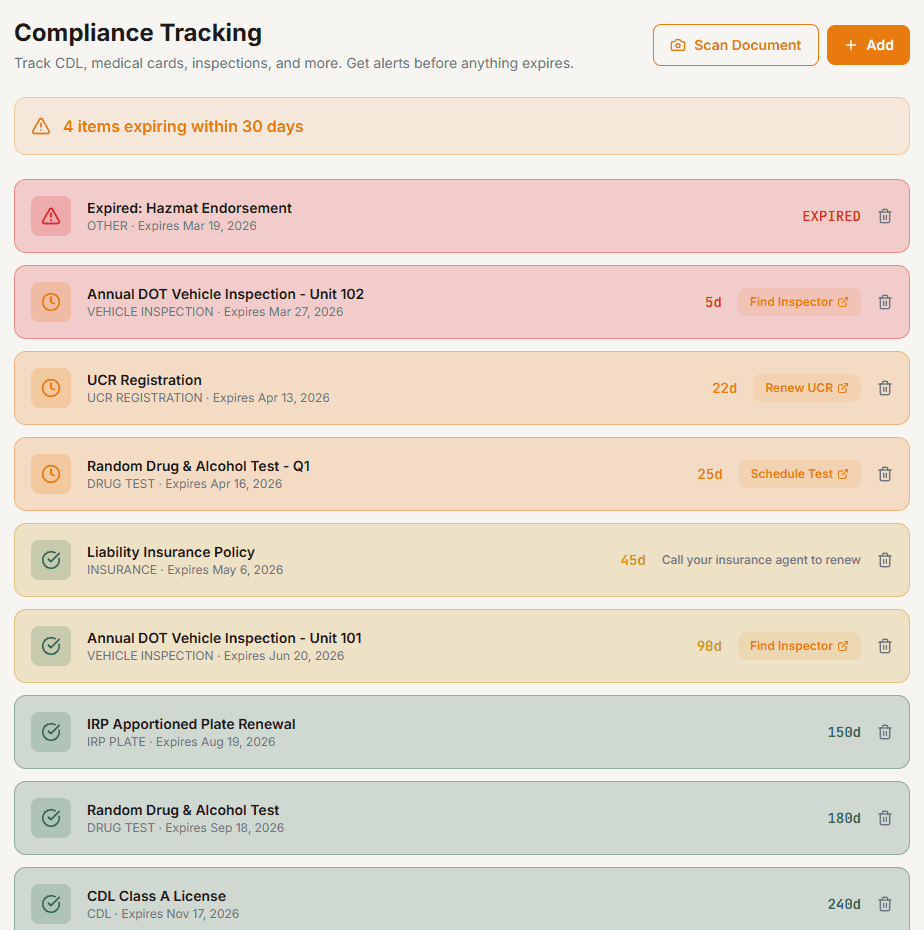
- Every item tracked with color-coded timelines
- Renewal reminders surface as deadlines approach
- All documents scanned and filed digitally
- Dashboard shows compliance status at a glance
- Audit-ready records organized automatically
How OverTheRoad.AI handles this
Compliance on autopilot
- Track CDL, medical card, inspections, insurance, permits — everything in one place
- Color-coded timelines: green (current), yellow (expiring soon), red (expired)
- Renewal reminders surface on the dashboard before each compliance item expires
- Snap a document photo — it's sorted and filed to the right compliance item
Related Guides
Want your real cost per mile in 3 minutes?
Drop a settlement or rate con — our free analyzer pulls CPM, RPM, broker margin, and IFTA prep.