DOT Inspection Levels (1-6) Explained
Every DOT inspection is actually one of six standardized levels defined by the Commercial Vehicle Safety Alliance (CVSA). The level determines what gets checked, how long it takes, and what can put you out-of-service. Knowing the difference between a Level 1 and a Level 3 is the difference between a quick roadside stop and a 90-minute full vehicle teardown. Here's what each level covers and how to actually pass.
Last updated: 9 min readBy OverTheRoad.AI Team
DOT inspection levels summary
| Level 1 — North American Standard | Driver + vehicle. ~45-60 min. CVSA decal if clean. |
|---|---|
| Level 2 — Walk-Around | Driver + visible vehicle (no under-vehicle). ~30 min. |
| Level 3 — Driver/Credentials | CDL, medical, HOS, ELD only. ~15-20 min. |
| Level 4 — Special Study | One-time, narrowly focused. Rare. |
| Level 5 — Vehicle-Only | No driver present. ~30-45 min. |
| Level 6 — Enhanced NAS Radioactive | Highway-route-controlled radioactive material. Highly specialized. |
| Out-of-service triggers | Major brake violations; tire tread below 2/32" on a steer/front tire or below 1/32" on any other tire; CDL expired; no medical card; HOS log violations. (Separately, the FMCSA citation minimum under 49 CFR 393.75 is stricter — 4/32" on steer tires and 2/32" on all others.) |
| Effect on CSA | Inspections WITHOUT violations improve your score. Avoiding inspections does NOT help. |
| CVSA decal | Issued for Level 1 (or Level 5) with no violations. Shows the inspection month; inspectors may pass a recently-inspected truck, but it's discretionary — not a guaranteed waiver. |
Quick Overview: All 6 Levels
| Level | Name | Typical Duration | Vehicle & Driver? |
|---|---|---|---|
| Level 1 | North American Standard (Full) | 45–60 minutes | Both |
| Level 2 | Walk-Around Driver / Vehicle | 30 minutes | Both |
| Level 3 | Driver-Only | 15–20 minutes | Driver only |
| Level 4 | Special (Study-Specific) | Varies | Varies |
| Level 5 | Vehicle-Only (No Driver) | 30–45 minutes | Vehicle only |
| Level 6 | Enhanced (Radioactive Materials) | 60+ minutes | Both |
Level 1: The Full Inspection
Level 1 is the most comprehensive — 37 steps covering both the driver and the vehicle. This is the inspection you want to avoid if possible, because it checks everything and takes the longest.
What they check on the driver:
- CDL, medical card, and any required endorsements (hazmat, tanker, doubles/triples)
- ELD records / HOS logs for the previous 8 days
- DVIR (Driver Vehicle Inspection Report) for pre-trip
- Seat belt use
- Drug and alcohol evidence (the officer uses observation, not testing, unless there's cause)
What they check on the vehicle:
- Brakes (service, parking, trailer) — including going under the truck with a slack-adjuster gauge
- Tires (tread depth, sidewall damage, inflation, matched pairs)
- Lights and reflectors
- Steering and suspension
- Exhaust and fuel system
- Coupling devices (fifth wheel, kingpin, trailer hitch)
- Load securement (straps, chains, tarps, binders)
- Annual inspection sticker (must be current)
- Hazmat paperwork and placarding (if applicable)
- ELD functionality
Pro Tip
Level 1 is the inspection that feeds CSA Vehicle Maintenance most heavily. A single brake violation on a Level 1 can move your CSA percentile noticeably — the effect is larger for a small-fleet peer group than for a big carrier. The time investment in weekly brake adjustments pays back fast.
Level 2: The Walk-Around
Level 2 is the Level 1 minus the under-truck items (no crawling under, no slack-adjuster check, no pulling wheels). The officer walks around the vehicle, checks what's visible without getting under it, and reviews the same driver documents.
This is the most common inspection in practice — officers choose it when the truck looks basically fine from the outside but they still want a thorough look. 30 minutes, same documents, less mechanical detail.
If you pass Level 2, an officer may issue a CVSA decal showing the inspection month — meaning other inspectors who see your decal may pass you, though it's discretionary, not guaranteed.
Level 3: The Driver-Only Inspection
Level 3 inspections only check the driver, not the vehicle. They're common at weigh stations when traffic is heavy and the officer just wants a quick document review.
What they check:
- CDL and medical card
- ELD / HOS records
- Seat belt use
- Shipping papers and permits
- Drug/alcohol observation
- Vehicle registration and insurance paperwork
Level 3 takes 15–20 minutes and is the least invasive. It's also where most HOS violations get written — an ELD violation here hits your CSA Hours of Service BASIC hard.
Level 4: Special Inspections
Level 4 inspections are a catch-all for special studies or focused checks requested by FMCSA — for example, a focused safety study on a specific vehicle component, a particular driver population, or a particular freight type. They don't happen often to individual carriers.
If you encounter a Level 4, treat it the same as a Level 2 — be ready with all documents and cooperate fully. You'll typically know it's a Level 4 because it's part of a larger FMCSA coordinated event.
Level 5: Vehicle-Only (No Driver Needed)
Level 5 inspections happen without the driver present — usually at a terminal during a company audit or when the vehicle is at a maintenance facility. Inspectors can pull the truck and do a full mechanical inspection (similar to Level 1's vehicle side) without stopping you on the road.
Most one-truck OOs will never see a Level 5. If you do, it's usually tied to a compliance review or a cross-border operation where the truck is inspected but the driver isn't needed.
Level 6: Enhanced Radiological Inspection
Level 6 is specifically for vehicles carrying radioactive materials that require exclusive use. It combines a full Level 1 with additional checks: radiation screening, specific shipping paperwork verification, and escort vehicle compliance if required.
If you don't haul radioactive materials, you'll never see a Level 6. If you do, your carrier or the shipper will typically provide detailed prep — this isn't a level you'll be surprised by.
What Puts You Out of Service (OOS)
An "out-of-service" order means you can't move the truck until the issue is fixed. The full OOS criteria are maintained by CVSA (North American Standard Out-of-Service Criteria), but the major categories:
- Brake violations: 20% or more defective brakes, air leaks, pushrod stroke exceeding limits
- Tire violations: Less than 2/32" tread on front; less than 1/32" on any other; sidewall damage to cords
- Driver OOS: Expired CDL, expired medical card, 11-hour or 14-hour HOS violation, false logs, no DQ file, no ELD
- Structural: Severe frame cracks, missing safety devices, unsecured load, exhaust leak into cab
- Lighting: Required lights not functioning (headlights, brake lights, turn signals, marker lights)
- Steering / suspension: Excessive play, broken springs, unsafe leaf configurations
An OOS order means the truck stays put until repaired. For small OOs, a single OOS event can cost a day of revenue ($1,000–$2,500), a tow bill ($300–$800), repair costs, and a CSA hit that lingers for 24 months.
How to Prepare for Any Inspection
- Keep your paperwork in a dedicated folder(or phone app) in the cab: CDL, medical card, registration, insurance cert, IRP cab card, IFTA license, DVIR pad, current rate con.
- Do real pre-trips. A 10-minute pre-trip every morning catches most of the common items DOT looks for in Level 1/2.
- Check your annual inspection sticker. An expired sticker is a guaranteed inspection AND a likely violation.
- Know your ELD. Be able to log out driving events, show an 8-day log, transfer data via email or USB on demand.
- Keep a clean truck cab. Officers don't issue violations for a dirty cab, but visible neglect (trash, missing seatbelts, warning lights on) invites a more thorough look.
- Be polite and cooperative. DOT officers have significant discretion. Being professional can be the difference between a close call getting written up as a warning versus a citation.
How OverTheRoad.AI handles this
One compliance calendar, every renewal you can't afford to miss
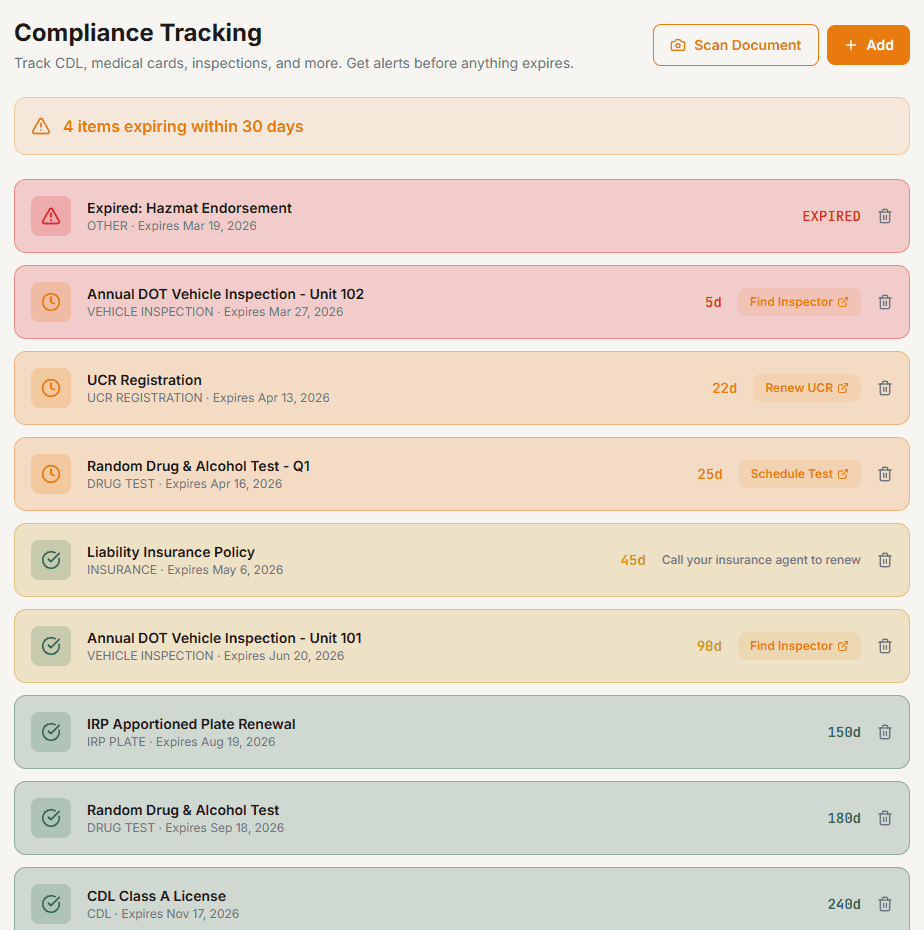
- Annual DOT inspection, CDL, medical card, insurance, IRP — all tracked in one view
- Color-coded timelines (green/yellow/red) flag what's expiring before an officer does
- Scan your inspection report with the app — it's filed to the right compliance item automatically
- Document archive keeps every sticker photo, renewal receipt, and repair order searchable for 4+ years of audit history
CVSA Roadcheck (The Annual Blitz)
Once a year (usually May), CVSA runs International Roadcheck — a 72-hour coordinated inspection blitz across the US, Canada, and Mexico. Tens of thousands of inspections happen in that window, and historically a meaningful share of vehicles and drivers get placed out of service. For exact current-year numbers, CVSA publishes the results afterward at cvsa.org.
Some drivers park during Roadcheck to avoid the blitz. Others run it normally with the logic that if your truck can't survive a Level 1, you shouldn't be running anyway. Either approach is valid — but if you haul during Roadcheck, pre-trip extra carefully.
Frequently Asked Questions
What's the most common DOT inspection level?
Level 2 (Walk-Around) is the most common on the road — officers use it when they want a thorough look without crawling under the truck. Level 3 (Driver-Only) is common at weigh stations when traffic is heavy. Level 1 (Full) is reserved for trucks where the officer saw something specific that warrants the extended look.
How long does a DOT inspection take?
Level 1: 45–60 minutes. Level 2: 30 minutes. Level 3: 15–20 minutes. Level 5: 30–45 minutes (without driver). Actual time depends on how your paperwork and truck are organized — a well-prepared driver can shave 10–15 minutes off any level.
Does every DOT inspection show up on my CSA score?
Every inspection with an actual violation or out-of-service order is logged in your CSA data. Clean inspections (no violations) also appear and actually help your score by building a track record of clean events in your safety-event group.
What's the difference between a warning and a violation?
Both get logged in your CSA data. A warning means no fine was issued; a violation means a citation was written. The CSA impact is similar either way — warnings still count toward your BASIC percentile. Contesting warnings in court is rarely worth it; contesting them via DataQs if the data is factually wrong is absolutely worth it.
Can I refuse a DOT inspection?
No. Commercial motor vehicles operating interstate are subject to inspection under federal law. Refusing an inspection is a serious violation that can result in out-of-service, criminal charges, and authority revocation. You have the right to be treated professionally and to appeal any finding through DataQs, but you can't refuse the stop.
What is a CVSA decal and how do I get one?
A CVSA (Commercial Vehicle Safety Alliance) decal is issued to vehicles that pass a Level 1 or Level 5 inspection without any OOS violations. The decal shows the month the inspection was done. Inspectors who see a recently-issued decal may pass your vehicle since it was recently thoroughly checked — but that's discretionary, not a guaranteed waiver. You don't apply for one — you earn it by passing a qualifying inspection clean.
Related Guides
Want your real cost per mile in 3 minutes?
Drop a settlement or rate con — our free analyzer pulls CPM, RPM, broker margin, and IFTA prep.