How to Start a Trucking Company (2026)
Starting a trucking company is not hard. Building one that lasts is — many new carriers fail within their first 1–2 years, and industry-wide churn on new motor-carrier authorities is notoriously high. The carriers that wash out tend to fail for the same reasons: undercapitalized on day one, no back-office system, and booking loads that lose money without realizing it. This guide walks through the entire arc, from forming your LLC to booking your first load, with real costs and the specific mistakes that kill new carriers.
Last updated: 15 min readBy OverTheRoad.AI Team
New trucking company startup at a glance
| Total time (CDL → first load) | ~90 days from zero |
|---|---|
| Cash startup cost (financed truck) | $20,000 - $50,000 |
| Cash startup cost (truck owned) | $10,000 - $20,000 |
| FMCSA authority application fee | $300 (single authority) |
| FMCSA public protest period | 21 days from OP-1 application filing (runs concurrently with insurance + BOC-3) |
| Annual insurance (year 1) | $10,400 - $18,200 (primary + cargo + physical damage) |
| First-year UCR | About $46 (1-2 vehicles; the fee is set annually by the UCR Board) |
| Year-1 IFTA license | $8 - $25 base state filing + $4-$10 per decal |
| Common failure window | Many new carriers fail within their first 1–2 years (cash-flow related) |
The Big Picture: 8 Steps, Roughly 90 Days
If you start from zero today, the critical path looks like this:
- Step 1: Get your CDL (if you don't have one) — 4–8 weeks
- Step 2: Form your LLC — 1–2 weeks
- Step 3: Apply for MC/DOT authority — processing takes 4–6 weeks
- Step 4: Buy or lease a truck — 1–4 weeks depending on financing
- Step 5: File insurance (BMC-91) — happens during the 21-day Federal Register posting
- Step 6: File BOC-3, IRP, UCR, Form 2290, IFTA decals — 1–2 weeks
- Step 7: Enroll in a drug-testing consortium and set up your back office — 1 week
- Step 8: Book your first load
The steps can overlap — you can form your LLC while finishing CDL training, for example. But MC/DOT authority is the longest single wait: the public protest window is 21 days at minimum, and with FMCSA vetting plus the required filings, activation commonly runs 4–6 weeks (sometimes longer).
Step 1: Get Your CDL
A Class A CDL is required for any truck-trailer combination over 26,000 lbs GVWR (which is every real freight truck). If you already have one, skip to Step 2. If not, the options are:
- Private CDL school: $3,000–$8,000, 4–8 weeks full-time. Fastest path. Shop aggressively — prices vary 3x between schools in the same city.
- Community college CDL program: $1,500–$4,000, often 10–16 weeks. Cheaper but slower.
- Company-sponsored training: Free in dollars, but you sign a 12–18 month contract to drive for them first. Bad deal if your plan is to become an owner-operator quickly.
As of February 2022, FMCSA requires Entry-Level Driver Training (ELDT) from a registered provider before you can take the CDL skills test. Verify your school is on the FMCSA Training Provider Registry before enrolling — some budget schools still aren't.
Step 2: Form Your LLC (or Don't)
You can run a trucking business as a sole proprietor, an LLC, or elect S-Corp status on an LLC. For most one-truck owner-operators, the answer is LLC with default tax treatment:
- Liability protection: If a load damages a shipper's cargo or your truck is in an accident, creditors can't come after your house or personal savings. Sole proprietors have no such protection.
- Cost: $50–$500 to register, depending on your state. Annual renewal fees $0–$800/year. Cheapest states: Kentucky, Arkansas, Mississippi. Most expensive: California ($800/year franchise tax), Massachusetts.
- Tax treatment: Pass-through by default — same tax return as a sole proprietor (Schedule C). No extra complexity. S-Corp election becomes worth it around ~$80–100K in net profit; before that, it's a headache.
Pro Tip
Form the LLC before you file for MC authority so the authority is issued to the LLC, not to you personally. Re-issuing authority later is a paperwork nightmare.
Step 3: Apply for MC and DOT Numbers
File with FMCSA through their Unified Registration System. You need:
- USDOT number: Free. Required for any commercial motor vehicle operating in interstate commerce.
- MC number (Motor Carrier): $300 one-time filing fee. Required if you're hauling for hire across state lines.
- EIN (Employer Identification Number): Free from the IRS. You need this even if you have no employees — it's required on the FMCSA application.
After filing, FMCSA posts your authority in the Federal Register for 21 days. During that window, you file insurance (BMC-91) and BOC-3 process-agent designation. If both are on file when the 21 days end, your authority goes active. If either is missing, the clock effectively restarts.
The #1 reason new carriers take 60+ days to activate is incomplete filings during the 21-day window. Get your insurance agent lined up before you file the MC application, not after.
Step 4: Get a Truck
You have three realistic options when you're starting out:
- Buy used outright: $25,000–$60,000 for a working 2015–2019 Freightliner Cascadia or Peterbilt 579. Requires cash or a commercial loan. Lowest monthly payment (or none). Most rewarding long-term.
- Finance a newer truck: $80,000–$180,000 loan for a 2020+ truck. Monthly payments $1,800–$3,500. Requires decent credit (ideally 680+). Lower risk mechanically but higher fixed-cost exposure.
- Lease-purchase from a carrier: Usually a trap. The truck, freight, and financing are all controlled by the same company; you can't shop rates; your "equity" often disappears if you miss a week. Only consider this if you have no other option — and even then, read the contract twice.
Whichever path you pick, budget for 3–4 months of operating capital (fuel, insurance, payments, food, permits) before you start. Your first invoice probably takes 30–45 days to get paid; that gap has killed more new carriers than anything else on this list.
Step 5: Insurance (The Biggest Single Expense)
Expect $8,000–$15,000/year for primary liability for a new authority carrier with a clean record. You'll also need cargo ($400–$1,200/year) and physical damage if your truck is financed.
Get quotes from at least three agents who specialize in trucking. Rates vary wildly — a bad agent on a good driver can be 40% higher than a good agent on the same profile. Expect a down payment of $2,500–$5,000 before coverage starts.
Your insurance agent files Form BMC-91 (or BMC-34 for surety bonds) electronically with FMCSA. Confirm the filing actually posted on the FMCSA system — don't just take the agent's word for it.
Step 6: The Compliance Pile
You still have a stack of paperwork to clear. The order matters — miss any item and your authority doesn't activate:
- BOC-3: $30–$50 one-time. Designates a process agent in every state. Must be on file before authority activates.
- IRP registration: $1,500–$3,000. Apportioned truck registration for interstate operation.
- UCR (Unified Carrier Registration): about $46/year for 1-2 vehicles (the schedule is set annually by the UCR Board and tiers up by fleet size). Annual renewal opens in the fall.
- Form 2290 (HVUT): $550/year for a 75,000-lb truck. Due August 31 or the first month of operation.
- IFTA license + decals: Free to $25. Quarterly filing required after activation.
- Drug-and-alcohol consortium enrollment: $50–$100 to enroll, $35–$75 per test.
- ELD (Electronic Logging Device): $20–$50/month. Mandatory for nearly all interstate operation.
Total out-of-pocket for Steps 5–6: around $12,000–$20,000 in the first 90 days, assuming you're not buying a truck outright.
Step 7: The Back Office (Where Most Carriers Fail)
By this point most new carriers have spent $20,000+ and haven't hauled a pound of freight. The temptation is to go "book a load first, figure out bookkeeping later." That's the move that kills companies. Without a system on day one, within 60 days you'll:
- Lose track of which brokers have paid you and which haven't
- Miss your first IFTA deadline (quarterly, $50 minimum penalty)
- Forget to renew something — usually your medical card or drug consortium — and hit an out-of-service order on the road
- Take loads that lose money because you never calculated your true cost per mile
- Owe your CPA $2,000+ at tax time to reconstruct the year from a shoebox of receipts
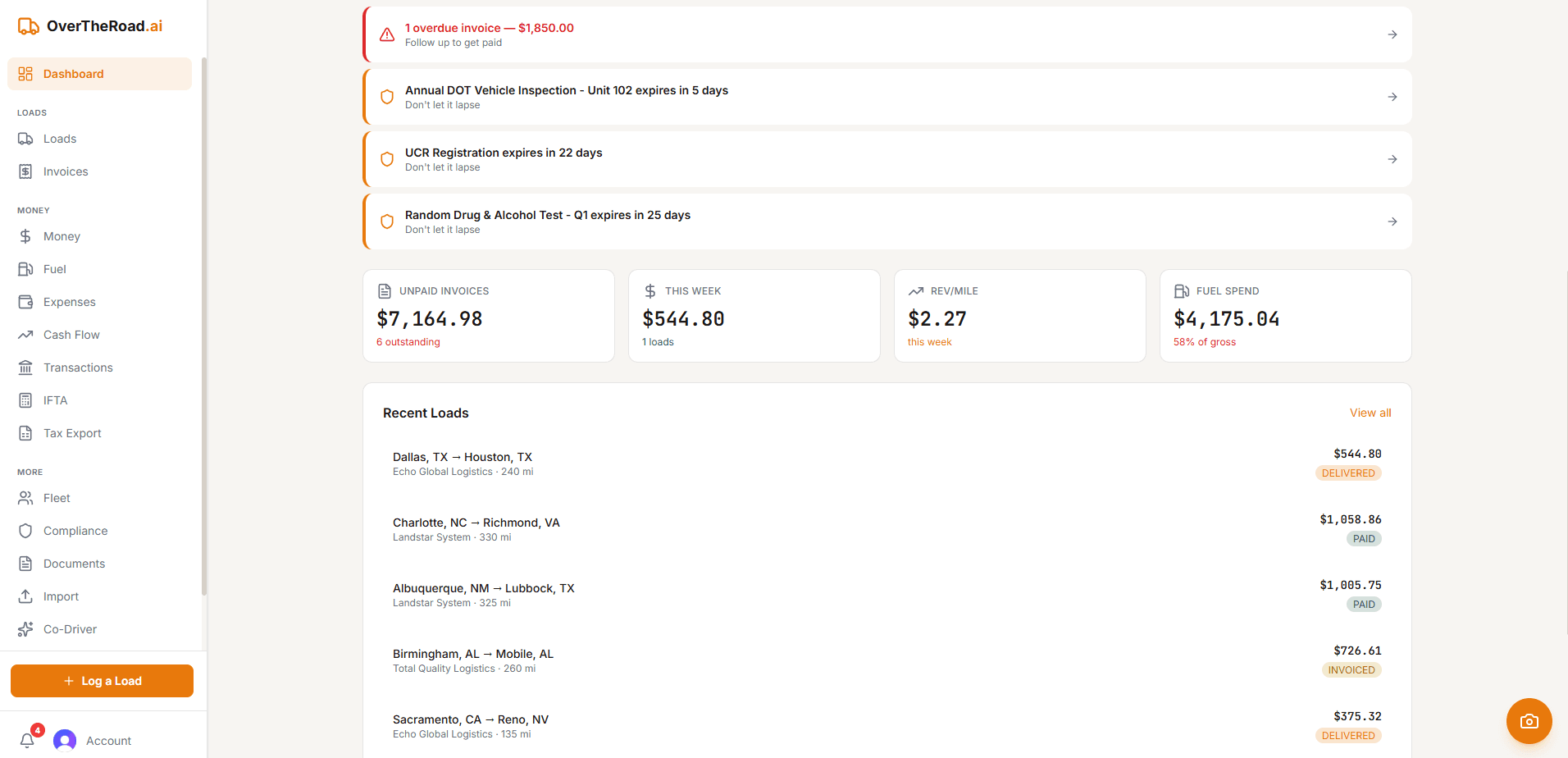
The system doesn't have to be fancy. It has to be in place before your first load. At minimum: a way to log every load, every expense, every fuel purchase, every compliance deadline, and your revenue per mile by broker.
How OverTheRoad.AI handles this
Skip the 90-day back-office scramble
- Enter your DOT number — OverTheRoad.AI pulls your FMCSA carrier info and pre-fills your setup
- Connect Samsara ELD with a 2-click OAuth flow; import fuel card data (EFS, Comdata, and other major cards)
- Compliance calendar populates with your renewal dates so no deadline catches you by surprise
- Scan a rate confirmation and the load logs itself — IFTA, invoicing, and profit scoring flow from there
Step 8: Book Your First Load
Before you touch a load board, know three numbers:
- Your break-even cost per mile. Fuel + insurance + truck payment + maintenance + permits + home overhead, divided by the miles you can realistically run in a month. For most new carriers this is $1.75–$2.10/mi.
- Your minimum acceptable rate. Break-even plus the margin you need to live. Rule of thumb: add $0.50–$0.80/mi for your first few months until you're sure your cost estimate is right.
- The deadhead: Empty miles between loads eat margin fast. A $3.00/mi load with 200 deadhead miles at the end might actually be $2.40/mi effective.
Popular load boards: DAT ($45–$150/month depending on tier), Truckstop, 123Loadboard. Almost all new OOs start here. The long-term play is to build broker relationships and eventually find direct shippers — but that's Year 2 work.
Frequently Asked Questions
How much money do I need to start a trucking company?
$30,000–$80,000 if you already own a paid-off truck. $100,000+ if you're financing a truck. The breakdown: $300 MC filing, $1,500–$3,000 insurance down payment, $1,500–$3,000 IRP, $30–$50 BOC-3, $550 Form 2290, about $46 UCR (1-2 vehicles), $50–$100 drug consortium, $500–$1,500 first-month ELD + load board + fuel card, plus 3–4 months of operating runway ($15,000–$40,000).
How long does it take to start a trucking company?
60–120 days from decision to booking your first load, assuming you already have a CDL. The slowest step is MC/DOT authority — FMCSA's 21-day Federal Register window plus 4–6 weeks of processing. Buying a truck and finalizing insurance happen in parallel.
Do I need a CDL before I can start a trucking company?
Only if you plan to drive the truck yourself. You can form an LLC, get MC/DOT authority, and hire a driver without a CDL — but most one-truck owner-operators are the driver, so practically speaking, yes. If you're starting with zero, get the CDL first; you can overlap LLC and authority work during CDL school.
Should I start with a lease-purchase carrier or buy my own truck?
Buy your own if you can possibly afford it, even if it's a higher-mileage used truck. Lease-purchase carriers control the truck, the freight, and the financing — three points of leverage over you. Most lease-purchase drivers end up back as company drivers with worse equity to show for it. The exception: if your credit is genuinely unworkable for a truck loan and you have no cash, lease-purchase may be your only path — read the contract twice before you sign.
Can I start a trucking company with bad credit?
Yes, but it's harder and more expensive. Insurance costs will be 20–40% higher. Truck financing may require a larger down payment (20–30%) or a co-signer. Some fuel cards will require a deposit. The parts of the process that don't care about credit (LLC, MC/DOT, CDL) are unchanged — so focus on those first while you build up a down payment.
What's the biggest mistake new carriers make?
Running out of cash. Specifically: underestimating how long the first invoice takes to pay (30–45 days is typical), overestimating how many miles they'll run (new carriers rarely clear 2,500 loaded miles/week in month one), and booking loads at rates that look fine but don't cover true cost per mile. All three are fixed by a real back-office system from day one, not month three.
Related Guides
Want your real cost per mile in 3 minutes?
Drop a settlement or rate con — our free analyzer pulls CPM, RPM, broker margin, and IFTA prep.