Owner-Operator vs Company Driver: The Real Math
Every year, thousands of company drivers ask the same question: is it worth going owner-operator? The recruiter pitches say yes. The bitter ex-O/Os on forums say no. The truth is simpler than either side makes it — but it depends on numbers most drivers never actually run. Here's the honest comparison.
Last updated: 12 min readBy OverTheRoad.AI Team
Pay comparison (rough industry benchmarks)
| Company driver pay | $0.55 - $0.75 / mile (W-2, varies by carrier) |
|---|---|
| Company driver gross (100k mi) | $55,000 - $85,000 / year |
| Owner-operator revenue | $1.80 - $3.00 / mile (1099) |
| Owner-operator gross (100k mi) | $180,000 - $300,000 / year (pre-expense) |
| Typical owner-operator NET | $60,000 - $120,000 / year (after expenses + SE tax) |
| Owner-operator fixed costs | $4,000 - $5,500 / month (truck + insurance + admin) |
| Self-employment tax | 15.3% on net SE earnings (vs. 7.65% as W-2) |
| Recommended cash buffer | $30,000+ to start as an owner-operator (on top of the truck down payment) |
The Gross-Pay Illusion
Recruiter ads pitch owner-operators at $200,000–$300,000 gross. They're not lying — that's a real gross revenue range for a solo owner-operator running hard. What they don't mention is that gross is not take-home. An owner-operator grossing $250,000 keeps roughly $65,000–$95,000 after fuel, insurance, truck payments, maintenance, taxes, and everything else.
A company driver at the same carrier might gross $75,000–$95,000, and keep $55,000–$72,000 after federal/state tax. The net gap is often smaller than the gross gap suggests. Whether it's worth it depends on what you do with the difference — and how much risk you're willing to carry.
A Realistic Year: Side-by-Side
Here's a fair comparison for a solo driver running ~120,000 miles/year:
| Line Item | Company Driver | Owner-Operator |
|---|---|---|
| Gross revenue | $85,000 | $240,000 |
| Fuel (~$4.00/gal, 6 MPG) | $0 | -$80,000 |
| Truck payment or depreciation | $0 | -$24,000 |
| Insurance (all types) | $0 | -$12,000 |
| Maintenance + tires | $0 | -$12,000 |
| Permits, IFTA, tolls, ELD, etc. | $0 | -$6,000 |
| Factoring / admin | $0 | -$4,000 |
| Net before tax | $85,000 | $102,000 |
| Self-employment + income tax est. | -$14,000 | -$22,000 |
| Take-home | ~$71,000 | ~$80,000 |
A $9,000 annual difference. Real — but not the $150,000 the recruiter pitch implied. And that's a best-case solo owner-operator with good equipment and good freight. A bad freight year, a blown engine, or one month of downtime can flip the math the other way.
Pro Tip
The single biggest variable hidden in that table is cost per mile. Most owner-operators never calculate theirs, which is how they end up taking $2.00/mi loads when their true break-even is $1.95 per mile — technically profitable, but no margin for anything that goes wrong.
What Nobody Tells You About Going Owner-Operator
- The first 12 months are the hardest financially.Insurance is at its highest, you don't have broker relationships, and every paid mile is offset by ramp-up costs. Expect to make less than you did as a company driver in year one.
- You're now running a business. Bookkeeping, IFTA, compliance tracking, invoice follow-up, broker vetting — that's 5–10 hours a week of unpaid office work on top of driving.
- Breakdowns are your problem. A blown turbo is $3,000–$5,000 and 3 days off the road. A transmission is $8,000–$15,000 and a week. No dispatch puts you on a reliever truck while yours is in the shop.
- Health insurance disappears. Most company drivers have employer-subsidized health coverage. Owner-operators pay ACA marketplace rates ($400–$1,200/month depending on family size and state), or do without.
- Retirement disappears. No company 401(k) match. You have to set up a SEP-IRA or Solo 401(k) yourself, and fund it from after-tax income.
What Nobody Tells You About Staying Company
- Your ceiling is lower. Company drivers generally don't cross $100,000 net. Owner-operators who run their business well can — sometimes considerably.
- Your freight quality is dictated by dispatch.You take what you're given. Owner-operators can refuse a load that doesn't pay enough; company drivers usually can't.
- You're easier to replace. Trucking companies cycle company drivers constantly. Your seniority has limited protection in a downturn.
- You're paid cents per mile, not dollars per load. A $3.00/mi load and a $1.80/mi load pay you the same per mile (e.g., $0.65 CPM) at most company carriers. The difference goes to the carrier.
When Owner-Operator Actually Makes Sense
It's the right move if:
- You have $30,000+ in savings so you can survive the first 90 days without revenue AND a major repair in year one.
- You have a clean 3+ year driving record (insurance rates are the #1 killer — a bad record makes the math not work).
- You're willing and able to run a business, not just drive a truck. If you hate paperwork, this will not go well.
- You understand your own cost per mile and can actually run a break-even analysis on a load before you book it.
- You want to build equity in a truck and eventually in a business — the 10-year upside is real, even if year one is rough.
When Staying Company Is the Right Call
- You don't have $30,000+ saved and no access to credit for 3–4 months of operating runway.
- You have tickets, accidents, or a DUI in the past 3 years — insurance costs will eat any upside.
- You're within 5–7 years of retirement. The ramp-up cost won't pay back in time.
- Your family depends on steady paychecks that can't be lumpy. Owner-operator income swings by $5,000–$10,000/month depending on freight season.
- You honestly don't enjoy the business side. Running a trucking company is ~30% trucking and 70% running a small business.
The Back-Office Tax You Don't See Coming
Here's what pushes a lot of owner-operators back to company driving: the math looks fine on paper, but the time cost of running the business is brutal. 5–10 hours a week of bookkeeping, IFTA, compliance tracking, and invoice follow-up — at a loaded rate of $50/hour, that's $12,000–$26,000 a year of your own labor you're not billing for.
Most owner-operators treat this as inevitable. It's not. The reason a $50M fleet runs at 3x the margin of a one-truck owner-operator isn't because they haul different freight — it's because they have systems that eliminate the administrative drag. The tooling to do the same thing on one truck has existed for about five years now.
How OverTheRoad.AI handles this
The back-office a big carrier runs on — for one truck
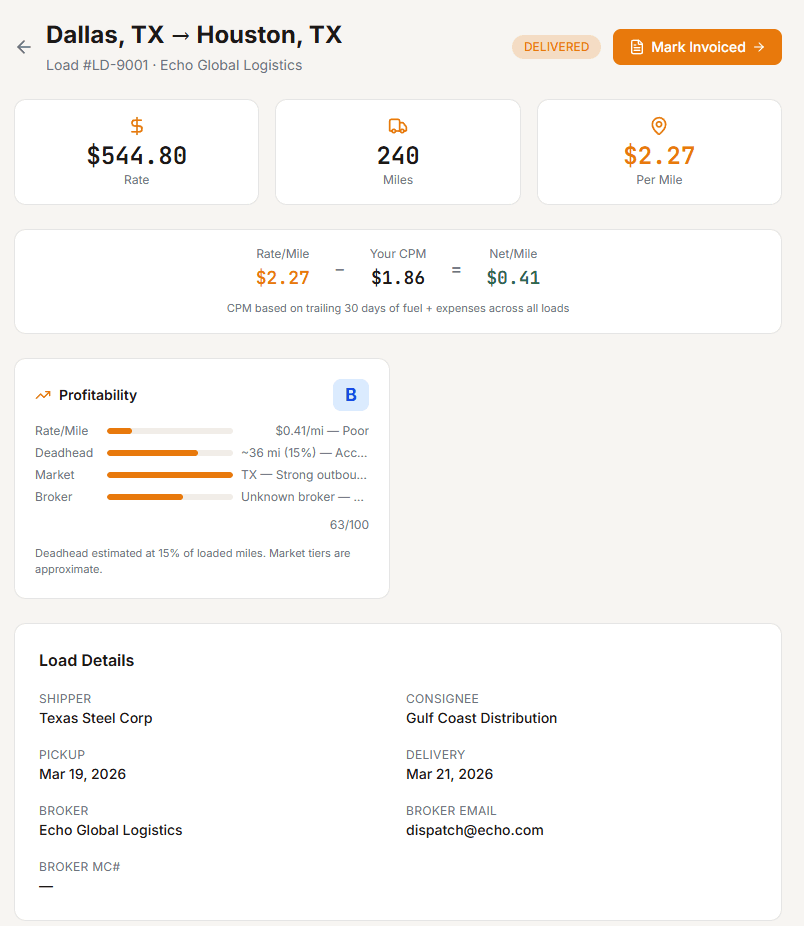
- Every load grades A–F on profitability before you confirm it — no more taking a $1.90/mi load without realizing it
- IFTA prepared automatically from your Samsara ELD and fuel card — saves 4+ hours every quarter
- See which brokers actually pay on time and which stretch to Net 60 — stop taking loads from the slow ones
- Compliance calendar with renewal reminders — no more medical-card surprises on the road
The Middle Path: Lease-Purchase (Usually a Trap)
Carriers pitch lease-purchase as the "stepping stone" to owner-operator status. For most drivers, it's a worse version of both options: you take on the costs of an OO (truck payment, fuel, maintenance) but the carrier still dictates your freight and skims margin at the top. If you miss a week for breakdowns, your "equity" can evaporate.
Exceptions exist — a few well-structured programs at reputable carriers work out for disciplined drivers. But if you're considering one, have a trucking attorney review the contract before you sign. The $500 in legal fees pays for itself many times over.
Frequently Asked Questions
How much more does an owner-operator make than a company driver?
On average, $5,000–$15,000 more per year in take-home after all costs, for a solo OO in their 2nd–3rd year with good equipment. Year one typically pays less than a company driver because of startup costs and ramp-up. Top owner-operators (well-run, good freight, owned equipment) can clear $20,000–$40,000 more; poorly run owner-operators lose money.
What percentage of owner-operators fail?
Industry estimates put new-authority failure rates at 80–90% within the first 2 years. The specific causes cluster around under-capitalization, single equipment failure events, and booking loads at rates below true cost per mile. All three are preventable, but they require discipline most new owner-operators underestimate.
How much should I save before going owner-operator?
Minimum $30,000 on top of your truck down payment — covers 3–4 months of operating expenses plus one major repair ($5,000–$10,000 buffer). $50,000+ is safer. Less than $20,000 and you're one bad month from being forced back to company driving.
Is it better to lease or own my truck as an owner-operator?
Owning (even a used truck) is almost always better than lease-purchase through a carrier. Financing your own used truck through a commercial lender puts you in the driver's seat on freight, maintenance, and eventual resale. Lease-purchase agreements with your carrier bind you to their freight network and their terms.
How many miles does a successful owner-operator run per year?
110,000–140,000 loaded miles/year is a healthy range for a solo owner-operator running regional-OTR. Going much higher means you're sacrificing sleep or home time; going much lower usually means the math doesn't work. Team drivers can push to 220,000+.
Do I need business experience to become an owner-operator?
Not formal experience, but you need the willingness to learn — you're running a small business with trucks as inventory. Bookkeeping, IFTA filing, compliance tracking, and basic tax planning are all learnable, but they're not optional. Drivers who treat the business side as an afterthought are the ones who end up back as company drivers.
Related Guides
Want your real cost per mile in 3 minutes?
Drop a settlement or rate con — our free analyzer pulls CPM, RPM, broker margin, and IFTA prep.