Owner-Operator Tax Deductions & Expenses
As an owner-operator, your truck is your business. Almost every dollar you spend to keep it running is a potential deduction. Missing even a few categories can cost you thousands at tax time. Here's the full list with typical cost ranges.
Last updated: 14 min readBy OverTheRoad.AI Team
2026 owner-operator tax deductions reference
| Per diem — full day (CONUS) | $80/day per IRS Notice 2025-54 (Oct 1, 2025 – Sep 30, 2026), 80% deductible |
|---|---|
| Per diem — partial day | $60/day (75% of full-day rate) |
| Effective per-diem deduction | $64/day full / $48/day partial after the 80% limit |
| Standard mileage rate (business) | 72.5¢ / mile per IRS Notice 2026-10 (effective Jan 1, 2026) |
| Section 179 deduction limit | $2,560,000 in 2026 (phase-out begins at $4,090,000) |
| Bonus depreciation | 100% on qualifying property placed in service after Jan 19, 2025 (One Big Beautiful Bill Act) |
| Self-employment tax rate | 15.3% on net SE earnings (12.4% SS + 2.9% Medicare) |
| SE tax deduction | 50% of SE tax is deductible above the line |
| Estimated tax due dates | April 15, June 15, September 15, January 15 |
| Schedule C | Sole prop / single-member LLC reports profit/loss here |
| Form 1120-S | S-Corp election filed separately; payroll handled through W-2 |
Fuel (30–40% of Revenue)
Your biggest expense and your biggest deduction. Every gallon of diesel you buy for business use is deductible. A typical solo owner-operator spends $50,000–$80,000/year on fuel. Keep every receipt — or better, use a fuel card that logs purchases automatically.
DEF (Diesel Exhaust Fluid) and reefer fuel are also deductible separately. If you use a major fleet fuel card (EFS, Comdata, and similar), your purchases can be categorized by state automatically — which also feeds your IFTA calculations.
Pro Tip
Fuel cards typically save somewhere in the range of a few cents per gallon at network stops. Over 80,000+ miles/year, that can typically add up to several hundred dollars or more in annual fuel savings before the tax deduction.
Truck Payment or Lease ($12,000–$30,000/year)
If you own your truck, you can deduct the cost through depreciation (typically over 3-5 years using MACRS). If you lease, your monthly lease payment is fully deductible as a business expense.
Section 179 allows you to deduct the full purchase price of a qualifying truck in the year you buy it, up to the current limit. For a $150,000 truck, that's a large deduction in year one. Talk to your CPA about whether Section 179 or standard depreciation is better for your situation.
This is general information, not personalized tax advice. Section 179 and bonus-depreciation rules change year to year and depend on your specific situation — confirm the details with your CPA before you file.
Insurance ($10,000–$20,000/year)
All business insurance premiums are deductible:
- Liability insurance — $8,000–$12,000/year (higher for new authority)
- Cargo insurance — $400–$1,200/year
- Physical damage / comprehensive & collision — $2,000–$5,000/year
- Bobtail / non-trucking liability — $300–$600/year
- Occupational accident insurance — $100–$200/month
- Workers' comp — if required in your state
Maintenance & Repairs ($10,000–$20,000/year)
Oil changes, tires ($400-$600 each, 18 on a semi), brakes, engine repairs, APU maintenance, trailer repairs — all deductible. A well-maintained truck averages $0.12-$0.18 per mile in maintenance costs.
Routine maintenance is expensed in the year it's paid. Major repairs or overhauls (engine rebuild at $15,000-$25,000) may need to be capitalized and depreciated — check with your CPA.
Per Diem / Meals ($15,000–$20,000/year)
The DOT per diem rate allows truck drivers to deduct a set amount per day for meals when away from their tax home overnight. The current transportation-worker M&IE rate is $80/day (IRS Notice 2025-54). The 80% deduction limit for transportation workers then applies, so the effective full-day deduction is roughly $64/day.
For an OTR driver away 300 days/year, that's approximately $19,200 in deductions. This is one of the largest and most commonly missed deductions for owner-operators (fuel and truck depreciation are usually larger).
Pro Tip
You can use the per diem method (flat rate per day) or track actual meal expenses. Most owner-operators use per diem because it's simpler, requires less recordkeeping, and is often higher than actual meal spend.
Permits, Fees & Licenses ($2,000–$5,000/year)
- IFTA license and decals — $0–$25
- IRP (International Registration Plan) — $1,500–$3,000
- UCR (Unified Carrier Registration) — about $46 (1–2 vehicle bracket)
- Heavy Vehicle Use Tax (Form 2290) — $550
- MC authority renewal — $300
- State permits and oversize/overweight permits — varies
- CDL renewal fees — $50–$100
- Drug testing and medical card fees — $100–$200
Other Deductible Expenses
- Tolls — $2,000–$8,000/year for Northeast/Midwest operators
- Parking — truck stop parking, scale fees
- ELD subscription — $25–$50/month ($300–$600/year)
- Cell phone — business-use percentage (typically 50-80%)
- Load board fees — DAT, Truckstop ($40–$150/month)
- Dispatch service fees — if you use a dispatcher (typically 5-10% of gross)
- Accounting & tax prep — CPA fees ($500–$1,500), bookkeeping software
- Lumper fees — $100–$300 per occurrence (if not reimbursed)
- Truck washes — $50–$100 each
- Shower credits — at truck stops
- GPS / satellite radio — if used for business
Common Audit Red Flags
The IRS pays attention to certain patterns:
- Claiming 100% business use on a truck you also drive personally — be honest about the split
- No receipts for large deductions — especially fuel and maintenance
- Per diem claimed for days you were home — only claim days you were away from your tax home overnight
- Mixing personal and business expenses — use a separate business bank account and fuel card
Track It or Lose It
You can only deduct what you can document. The IRS requires records for every business expense. Come tax time, you need categorized totals, not a shoebox of receipts.
How OverTheRoad.AI handles this
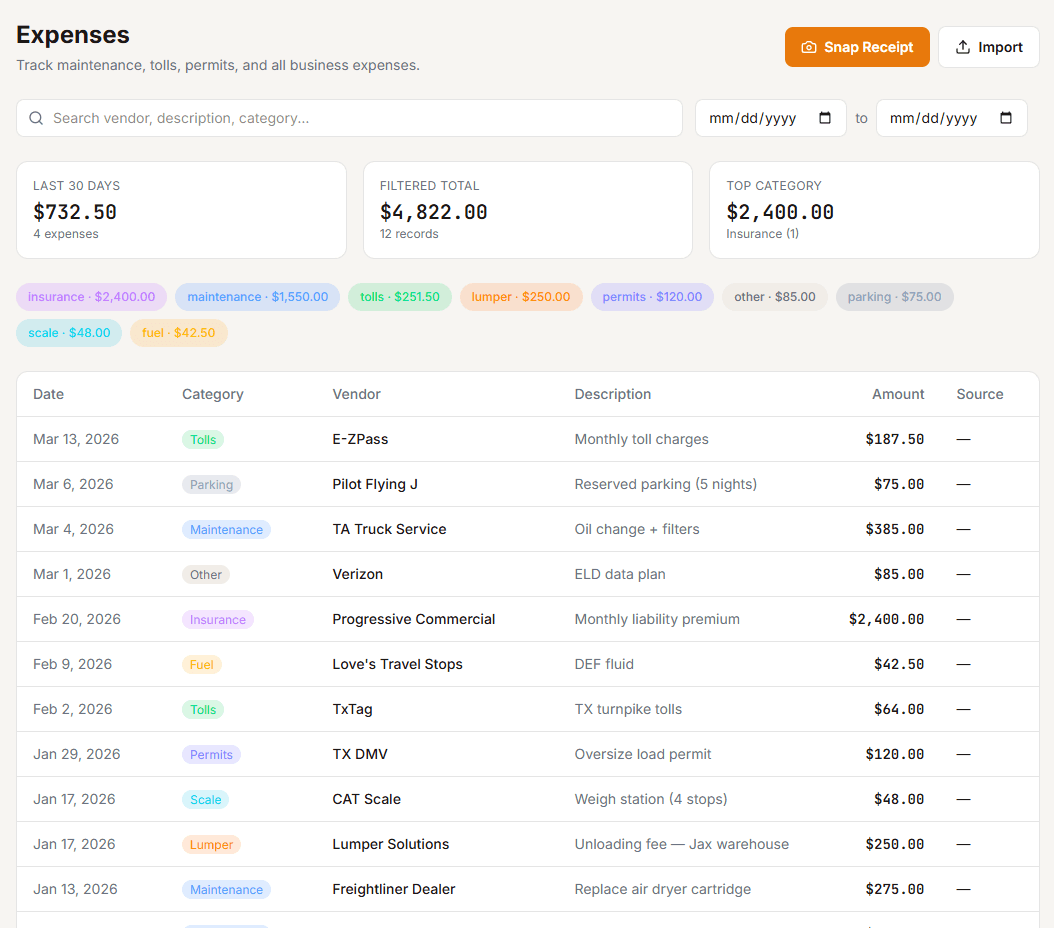
Every expense tracked and categorized automatically
- Fuel card imports from EFS, Comdata, and other major fleet cards — categorized by state
- Snap a receipt photo — it's filed to the right expense category
- Bank sync categorizes transactions automatically
- One-click tax export — hand it to your CPA and you're done
Related Guides
Want your real cost per mile in 3 minutes?
Drop a settlement or rate con — our free analyzer pulls CPM, RPM, broker margin, and IFTA prep.