
Trucker Per Diem 2026: Rates, Rules & How to Claim It
Per diem is one of the largest tax deductions most truck drivers can claim — yet every year hundreds of thousands of drivers either skip it entirely or miscalculate it and leave money on the table. This guide covers the 2026 rate, who qualifies, the rules that trip people up, and how to document it so your Schedule C survives an audit.
Last updated: 10 min readBy OverTheRoad.AI Team
2026 trucker per diem rates (per IRS Notice 2025-54)
| Full day rate (CONUS) | $80.00 per day (transportation industry rate, Oct 1, 2025 – Sep 30, 2026) |
|---|---|
| Partial day rate | $60.00 per day (75% of full-day, applied on first and last day of trip) |
| Deduction limit | 80% for transportation workers (vs. 50% for other industries) |
| Effective deduction (full day) | $64.00 per day after the 80% limit |
| Effective annual deduction (250 full days) | Approximately $16,000 after the 80% limit — illustrative; your day count and your CPA's figures will differ |
| Outside continental US (OCONUS) | $86.00 per day (transportation industry rate) |
| Documentation needed | Trip log showing dates away from home + general location. No meal receipts required when using the per diem method. |
| Where claimed (owner-operator) | Schedule C, line 24b (Deductible meals) — this is where the 80% limit applies; line 24a is Travel/lodging |
The 2026 Per Diem Rate
For the 2025–2026 federal fiscal year (October 1, 2025 through September 30, 2026), the IRS standard meal and incidental expenses (M&IE) rate for transportation workers subject to federal hours-of-service rules is $80 per full day. This is the rate most truck drivers use.
A few things the $80 number does not include:
- Lodging. Per diem covers meals and incidentals only. Hotel nights are deducted separately as travel expense.
- Home-base days. You only get per diem on days you're away from your tax home.
- Days you weren't actually on a trip. Days on home time, in the yard, or off-duty don't qualify, even if your truck was parked somewhere else.
Pro Tip
IRS rates refresh every October. The $80 rate is for FY2026 (Oct 2025 – Sep 2026). Before you file, double-check the IRS publication for the rate in effect during the portion of the year you're deducting.
Who Actually Qualifies for Trucker Per Diem
To claim the transportation-worker per diem rate, you must:
- Be subject to federal hours-of-service (HOS) regulations. This includes virtually all interstate CDL drivers running ELDs.
- Be away from your tax home overnight (or long enough to require sleep). A day trip where you came home to sleep doesn't count.
- Travel to an area outside your metropolitan tax home. "Tax home" is where your main place of business is — for most OOs, that's where you have your LLC registered and park the truck.
Company drivers, owner-operators, and independent contractor drivers all qualify. W-2 company drivers deduct it through Form 2106 and Schedule A (if they itemize — less common since TCJA caps). Owner-operators and 1099 drivers deduct it on Schedule C — where it's a much more valuable deduction.
The 80% Rule (This Is Where Most Drivers Undercount)
Here's the quirky part: for tax years from 2023 onward, transportation workers can deduct 80% of their per diem, not 100%. That's built into the way the IRS treats DOT-subject workers — more generous than the 50% limit that applies to other businesses, but less than 100%.
Example: 250 days away from home at $80/day:
- Gross per diem: 250 × $80 = $20,000
- 80% deductible: $20,000 × 0.80 = $16,000
- Your Schedule C deduction on Line 24b (Deductible meals): $16,000
Note: some bookkeepers record the full $20,000 and let the 80% reduction flow through the tax software. That's fine — just make sure it actually reduces to 80% before the final return.
Full-Day vs Partial-Day Per Diem
Not every day is a full-day per diem day. The IRS allows 75% of the rate (so $60 in 2026) for partial days. A day counts as a partial day if you:
- Depart from your tax home mid-day or later (not at 3 AM)
- Return to your tax home mid-day or earlier (before the evening meal)
A round trip that starts at 6 AM Monday and ends at 2 PM Thursday typically has: Monday partial ($60), Tue/Wed full ($80 × 2 = $160), Thursday partial ($60) = $340 gross, reduced to $272 deductible after the 80% rule.
Most OOs simplify by claiming full days on every day away from home, which overstates by a few hundred dollars a year. The IRS generally won't hassle you for small overclaims on per diem, but if you want to be precise, track first-day and last-day start/end times.
How to Document Per Diem (The Part Everyone Skips)
The IRS doesn't require receipts for per diem — that's the whole point of the standard rate. What they dorequire is proof that you were actually on a trip away from home those days. In an audit, that means showing:
- ELD / HOS records. Your electronic log is the gold standard — shows where you were and when. Retain 6 months minimum per FMCSA rules, longer for tax purposes.
- Load records. Rate confirmations with pickup and delivery dates establish you were on the road.
- Fuel purchases. A fuel receipt in Oklahoma on a day you claimed per diem is strong evidence you weren't home in Minnesota.
- A day count. Total days away from home, by month. This is the number your CPA plugs into the calculation.
Pro Tip
If you pay yourself per diem as an owner-operator, you don't need to actually spend $80 on food that day — the IRS accepts the standard rate whether you ate truck-stop pizza or nothing at all. Just document the days away from home.
Counting Your Days-Away Correctly
The biggest mistake most drivers make is undercounting days. A year has 365 days; a driver with typical OTR volume is away from home 200–280 of them. Drivers who say "I was only away 150 days" are usually forgetting:
- Nights spent at a truck stop on their way back home — they're still "away" that night
- Downtime waiting at a shipper or receiver — counts as away
- Breakdown days on the road while waiting for repair — counts
- Weekend stays waiting for a Monday appointment — count
A day is "at home" only if you're actually at your tax-home address and off-duty for a sleep period. Everything else is a travel day.
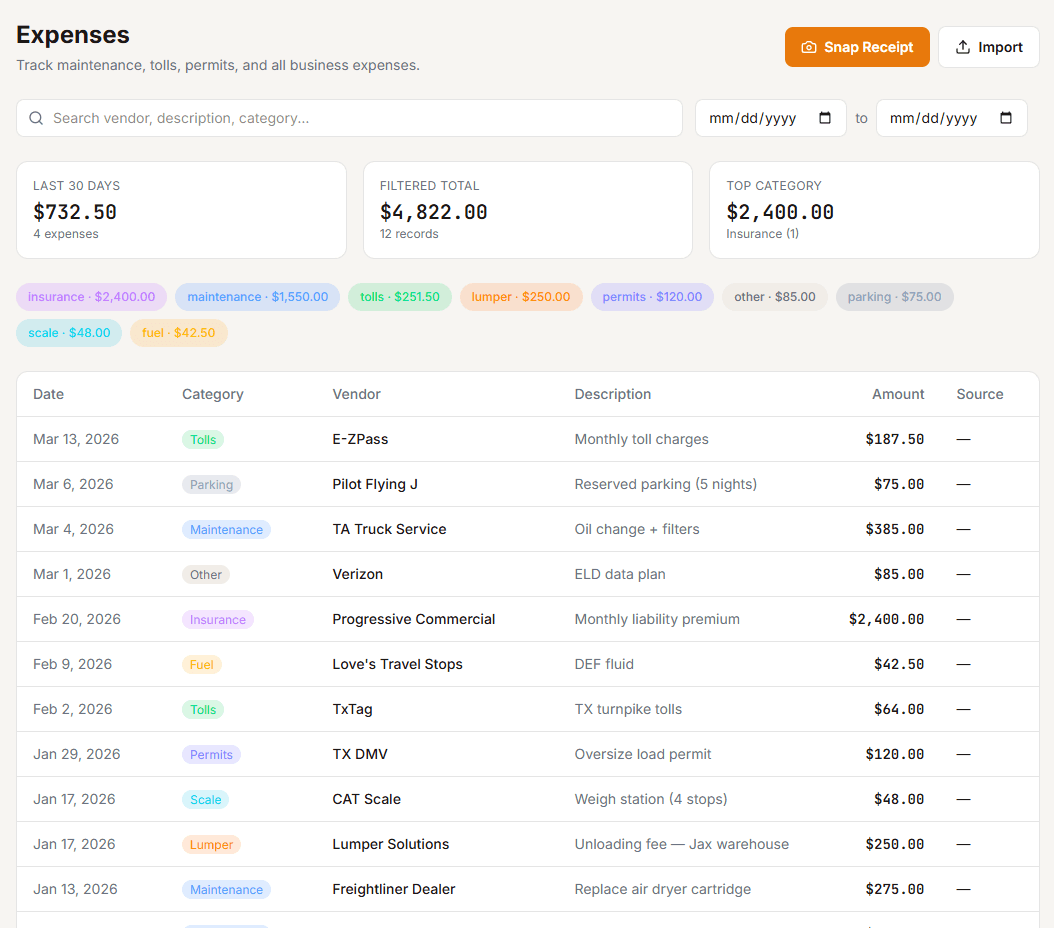
How OverTheRoad.AI handles this
The per-diem paper trail, already in one place
- Fuel receipts by state, rate cons with pickup/delivery timestamps, and BOLs — all stored and searchable
- Samsara ELD integration pulls your trip data so your away-from-home days are backed by on-duty records
- Schedule C export categorizes travel and meals cleanly for your CPA
- Document archive keeps every supporting receipt available in case of IRS review
Per Diem for W-2 Company Drivers (A Warning)
The Tax Cuts and Jobs Act (2017) eliminated the miscellaneous itemized deduction for W-2 employees at the federal level. Practically, under current law this means employee drivers generally can't deduct per diem on their federal return — but tax law changes, so check the rules in effect for your filing year:
- Company drivers on W-2 generally cannot deduct per diem on their federal tax return unless their employer pays it as a non-taxable reimbursement (an "accountable plan").
- If your carrier says they pay "per diem," check whether it's a wage reduction (they shift $X of taxable wage into non-taxable per diem) or a top-of-wage bonus. Shifting wages into per diem reduces W-2 income — which hurts Social Security, unemployment, and mortgage-qualifying income.
- Some states still allow per diem deductions on state returns even if federal doesn't. Check your state's rules.
For owner-operators and 1099 drivers, per diem remains fully deductible on Schedule C at the 80% rate. This is one of several tax advantages that flip the math on going owner-operator.
Frequently Asked Questions
What is the trucker per diem rate for 2026?
$80 per full day for US trucking workers subject to federal hours-of-service regulations, effective October 1, 2025 through September 30, 2026. Partial days (departure or return days) qualify at 75% of the rate ($60). The rate is then reduced to 80% deductible on your Schedule C.
Do I need receipts to claim per diem?
No — the IRS standard rate is specifically designed to skip the receipt requirement. You do need to document that you were actually away from your tax home on the days you claim. ELD records, fuel receipts, and rate confirmations are the standard proof.
Can W-2 company drivers claim per diem in 2026?
Generally no, at the federal level, because of Tax Cuts and Jobs Act changes that eliminated the unreimbursed employee business expense deduction. W-2 drivers can only access per diem benefits through their employer's accountable plan, where the carrier pays per diem as a non-taxable reimbursement. Some states still allow the deduction at the state level.
How many days of per diem can an owner-operator claim?
As many as you were actually away from home. Most OTR owner-operators legitimately claim 200–280 days per year. Regional drivers home on weekends might claim 150–200. Dedicated local drivers may claim under 100. The key is documenting the actual days; there's no cap.
Is per diem taxed?
For owner-operators, per diem isn't "income" — it doesn't show up as revenue. It's a deduction that reduces your taxable net income. For W-2 drivers on an accountable plan, employer-paid per diem is non-taxable to you (no federal income tax, no Social Security/Medicare).
Can I claim per diem for sleeping in my truck's sleeper berth?
Yes — sleeping in your sleeper berth counts as being away from home overnight, as long as you're more than a commute from your tax home. This is the most common form of "lodging" for OTR drivers and it qualifies.
Related Guides
Want your real cost per mile in 3 minutes?
Drop a settlement or rate con — our free analyzer pulls CPM, RPM, broker margin, and IFTA prep.