
Form 2290 Heavy Vehicle Use Tax — Filing Guide
Form 2290 is one of those annual filings every interstate trucking company has to do, but most drivers learn about it for the first time when their IRP registration gets rejected. Miss the deadline and the penalty stacks up fast. Here's exactly what Form 2290 is, who owes it, and how to e-file it in under 15 minutes.
Last updated: 9 min readBy OverTheRoad.AI Team
Form 2290 HVUT at a glance
| Tax year | July 1 – June 30 (federal HVUT period) |
|---|---|
| Due date | August 31 of the start of the tax period (or last day of month after first use) |
| Vehicle threshold | 55,000 lbs taxable gross weight or more |
| Tax (55,001 - 75,000 lbs) | $100 + $22 per 1,000 lbs over 55,000 |
| Maximum tax (over 75,000 lbs) | $550 per vehicle |
| E-file required | Fleets of 25+ trucks |
| Penalty (failure to file) | 4.5% of tax owed per month for up to 5 months (max 22.5%) — plus a separate 0.5%/month late-payment penalty and interest |
| Stamped Schedule 1 | Required for IRP plate renewal in most states |
| Suspension category | Vehicles driven 5,000 mi/year or less (7,500 for agricultural) qualify for suspended-tax status — still must file |
What Form 2290 Is (And Isn't)
Form 2290 is the IRS form for paying the Heavy Vehicle Use Tax (HVUT) — a federal tax on heavy trucks operating on public highways. The tax amount depends on the taxable gross weight of your truck.
What Form 2290 is not:
- Not the same as IFTA fuel tax (that's quarterly, state-level)
- Not the same as IRP registration (that's state-administered truck registration)
- Not the same as UCR (that's interstate carrier registration)
- Not optional — any truck over 55,000 lbs GVWR owes it
The output you care about is the stamped Schedule 1— a one-page IRS receipt proving you paid. You need this to register your truck through IRP or your state DMV. Without it, you can't renew plates.
Who Owes Form 2290 Tax
You owe Form 2290 if you operate a vehicle on public highways with a taxable gross weight of 55,000 lbs or more. That covers:
- Nearly every Class 8 truck (typical OTR tractor-trailer)
- Most Class 7 vehicles running commercial
- Some heavy hotshots with combined truck + trailer weight over 55K
Exemptions exist for:
- Low-mileage vehicles: Trucks expected to run 5,000 miles or less on public highways annually (7,500 for agricultural vehicles). You still file the form but owe no tax.
- Government-owned vehicles
- Certain vehicles used exclusively for agricultural purposes within 150 miles of the farm
How Much You Owe
HVUT is calculated based on the taxable gross weight of the vehicle. For most Class 8 trucks running at 80,000 lbs, the full annual tax is $550. Weight-based tiers:
| Taxable Gross Weight | Annual Tax |
|---|---|
| 55,000 lbs (minimum) | $100 |
| 55,001 – 75,000 lbs | $100 + $22 per 1,000 lbs over 55,000 |
| 75,001 lbs and up | $550 (maximum) |
Most owner-operators pay the full $550 because their trucks register at 80,000 lbs. If you're running a lighter rig (smaller tractor, hotshot, some flatbed configurations), the tax tiers down proportionally.
When It's Due (This Is Where Most Drivers Mess Up)
The HVUT year runs July 1 through June 30 — not January through December. That catches a lot of new drivers off guard. The filing deadlines work like this:
- Annual filing: For trucks in use July 1, Form 2290 is due by August 31 of the same year.
- New-truck or first-use filing: If you put a truck into service in a month other than July, file by the last day of the month following first use. (Example: truck first used in March → due April 30.)
- Partial-year tax: If you first use the truck mid-year, your tax is prorated based on months of use. A truck first used in March pays 4/12 of the annual amount (March, April, May, June).
Pro Tip
Most new owner-operators file Form 2290 immediately after getting their MC authority because they can't register the truck through IRP without the stamped Schedule 1. That's the right instinct — don't wait.
How to File (E-file Is the Only Reasonable Way)
The IRS accepts paper or e-filing, but paper returns take 4–6 weeks to process and you can't get a stamped Schedule 1 that way (well, you can — it comes back in the mail). E-filing returns the stamped Schedule 1 electronically, usually the same day — sometimes within 30 minutes.
E-file through one of these services:
- Any IRS-approved e-file provider (current list at irs.gov). Prices range from $14 to $50 per vehicle.
- Providers are all IRS-approved and compete on price and UX — pick from the current list on irs.gov rather than a name that may have changed.
What you need to have ready:
- EIN (not SSN — the IRS rejects 2290 with SSNs)
- VIN for each vehicle being reported
- Taxable gross weight of each vehicle
- Date of first use for each vehicle
- Bank info for electronic funds withdrawal (or a credit card)
Step-by-Step E-File Walkthrough
- 1. Pick an IRS-approved e-file provider from the list at irs.gov. Most charge $15–$25 for a single vehicle.
- 2. Enter your business info: Legal name, address, EIN. This must match IRS records exactly — mismatches are the #1 reason 2290 returns get rejected.
- 3. Enter vehicle info: VIN, taxable gross weight, date of first use. If you have multiple trucks, you can list them all on one return.
- 4. Review tax calculation: The service calculates your tax based on weight and first-use month. Most full-year Class 8 trucks are $550.
- 5. Pay the tax via EFW (electronic funds withdrawal from your checking account) or credit card. EFW is free; credit card adds a convenience fee.
- 6. Receive your stamped Schedule 1 via email — typically 15 minutes to 2 hours after successful submission. Save the PDF; print a few copies.
Penalties for Missing the Deadline
Late-filing penalties for HVUT:
- Failure to file: 4.5% of the unpaid tax per month for up to 5 months (a maximum of 22.5%)
- Failure to pay: a separate 0.5% of the unpaid tax per month, plus interest
- Most painful: No stamped Schedule 1 means you can't renew your state registration or IRP — which means you can't legally operate
On a $550 tax, the late-filing penalty caps at about $124 (22.5%), with the separate late-payment penalty and interest added on top. The real cost isn't the fine — it's that you're parked until you file. A week of downtime is $5,000–$10,000 in lost revenue.
Common Mistakes That Get Returns Rejected
- Using SSN instead of EIN. The IRS will not accept Form 2290 under an SSN. Get an EIN first (it's free at irs.gov; instant online).
- Business name mismatch. The name on Form 2290 must exactly match IRS records for the EIN. Even "Smith Trucking LLC" vs "Smith Trucking, LLC" (with the comma) can cause rejection.
- Wrong VIN. Transpose two digits and the whole return rejects. Copy VINs from the title — don't type from memory.
- Wrong first-use date. If you put the truck into service in March, put March — not "July 1" as a default. Wrong first-use date means wrong tax amount.
- Filing too early. You can't file for July 1 until July 1. Filing in June for the upcoming tax year gets rejected.
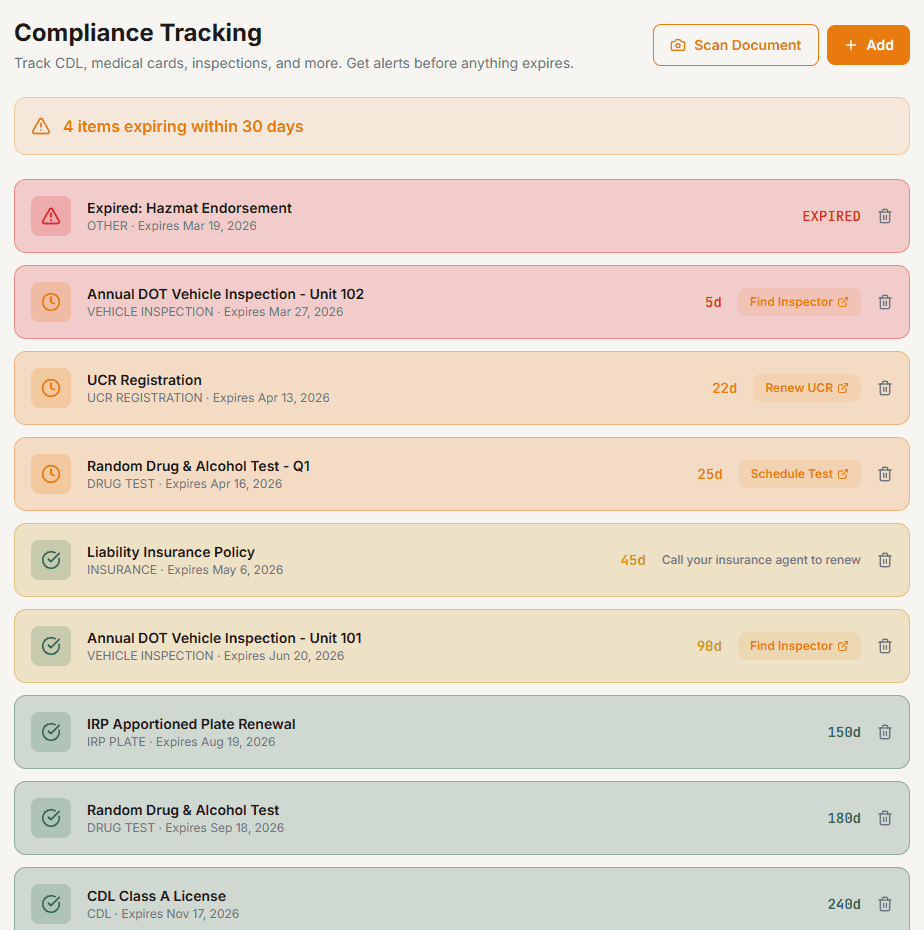
How OverTheRoad.AI handles this
One renewal you don't want to miss
- Form 2290 renewal date tracked on your compliance calendar alongside CDL, medical card, and annual inspection
- Stamped Schedule 1 stored with your compliance docs — ready to pull for IRP, state DMV, or broker packets
- Quarterly estimated-tax reminders (Apr 15, Jun 15, Sep 15, Jan 15) with email + in-app notifications built in
- Audit-ready paper trail: every renewal date, every receipt, and every filing confirmation stays in one place
Amendments and Corrections
Things that can require a 2290 amendment:
- Suspended vehicle exceeds mileage. If you filed a low-mileage exemption and then drove more than 5,000 miles (7,500 for ag), file an amended 2290 and pay the tax.
- Weight change. If you increase the taxable gross weight mid-year, file a weight-change amendment and pay the additional tax.
- VIN correction. If you typed the VIN wrong, file a VIN correction. This is free and fast.
Amendments are filed through the same e-file provider you used originally. Processing is usually same-day.
Can I Get a Refund?
Yes, in specific situations:
- Vehicle sold, destroyed, or stolen before the end of the HVUT period. File Form 8849 Schedule 6 for the prorated refund.
- Vehicle used less than 5,000 miles (7,500 for ag) during the period. You can claim the full tax as a credit on next year's return.
Refunds take 6–8 weeks via paper check. Most OOs just take the credit against the next year's filing, which is much faster.
Frequently Asked Questions
How much is Form 2290 tax for 2026?
For Class 8 trucks at 75,000+ lbs taxable gross weight, $550/year (the maximum). Lighter trucks tier down: $100 at 55,000 lbs, plus $22 per 1,000 lbs over that, capped at $550. Note the maximum $550 applies to trucks over 75,000 lbs; at exactly 75,000 lbs the formula gives $540. The tax year runs July 1 through June 30.
When is the Form 2290 deadline?
For trucks in use on July 1, the annual deadline is August 31. For trucks first put into service in other months, the deadline is the last day of the month following first use. Always file immediately after getting new authority — you need the stamped Schedule 1 to register your truck.
Do I need to file Form 2290 if my truck is under 55,000 lbs?
No. Trucks with a taxable gross weight under 55,000 lbs are exempt. But note: taxable gross weight includes the truck, permanently attached equipment, and the heaviest load you typically carry — so a light tractor pulling a loaded 48' trailer is almost certainly over 55,000 lbs.
Can I e-file Form 2290 myself?
Yes — and you should. IRS-approved e-file providers (listed at irs.gov) charge $14–$25 per vehicle. The process takes about 15 minutes if you have your EIN, VIN, taxable gross weight, and first-use month ready. You'll get your stamped Schedule 1 back by email, usually within 30 minutes to 2 hours of submission — fast enough to walk it into your IRP office the same day. Paper filing through the IRS takes 4–6 weeks for the Schedule 1 to come back in the mail, which is almost always too slow. Most new carriers e-file immediately after their MC authority activates so they can register the truck without delay.
What happens if I file Form 2290 late?
Late-filing penalty is 4.5% of the unpaid tax per month for up to 5 months (a maximum of 22.5%). A separate late-payment penalty of 0.5% per month plus interest applies too. On a $550 tax, the late-filing penalty caps at about $124, with late-payment penalty and interest on top. The real pain is operational: you can't renew state registration or IRP without a current Schedule 1, so you're parked until you file.
Is Form 2290 the same as IFTA?
No. Form 2290 is an annual federal tax on heavy vehicle use, paid to the IRS. IFTA is a quarterly state-level fuel tax redistribution program. Different forms, different agencies, different deadlines. Most carriers owe both.
Related Guides
Want your real cost per mile in 3 minutes?
Drop a settlement or rate con — our free analyzer pulls CPM, RPM, broker margin, and IFTA prep.