Trucking Authority Checklist
Your authority got filed. Now there's a list of things that must be in place before you can legally haul freight — miss any one of them and your authority won't activate, or you'll get shut down on the road. Here's every step with real cost ranges, the week-by-week timeline, and a checklist you can actually tick off as you go.
Last updated: 15 min readBy OverTheRoad.AI Team
Your working checklist
Tap items as you finish them — progress saves on this device
New authority startup costs (typical)
| Primary liability insurance | $8,000 - $15,000 / year (clean record) |
|---|---|
| Cargo insurance | $400 - $1,200 / year |
| Physical damage | $2,000 - $5,000 / year (varies by truck value) |
| BOC-3 process agent | $30 - $75 one-time |
| UCR registration (2026) | $46 (1-2 vehicles) up to $44,836 (1,001+) — set annually by the UCR Board |
| IFTA license + decals | $8 - $25 base state filing fee + $4-$10 per decal |
| IRP apportioned plate | $1,500 - $3,500 first year (depends on states) |
| ELD device + monthly fee | $200-$500 device + $20-$50/month |
| FMCSA public protest period | 21 days from OP-1 application filing (runs concurrently with insurance + BOC-3) |
1. Get Insurance ($8,000–$15,000/year)
Before your authority becomes active, you need to file proof of insurance with the FMCSA. This is typically the most expensive startup cost.
- Primary liability: $750,000 minimum for general freight. Hazmat carriers need $1M-$5M. Expect $8,000–$15,000/year for a new authority with clean record.
- Cargo insurance: Typically $100,000 coverage. $400–$1,200/year. Some brokers require $250K.
- Physical damage: Covers your truck. Not required by FMCSA but required by most lenders. $2,000–$5,000/year depending on truck value.
Your insurance agent files Form BMC-91 (or BMC-34 for surety bonds) with the FMCSA. Your authority won't activate until this is on file — typically takes 2-3 business days to process.
Pro Tip
New authority insurance is expensive. Get quotes from at least 3 agents who specialize in trucking. Rates drop significantly after 1-2 years with a clean record. Some agents require a $2,500-$5,000 down payment.
2. File BOC-3 Process Agent ($30–$75)
A BOC-3 designates a process agent in every state where you operate. It's required by the FMCSA. Most services charge $30-75 one-time and file it for you. Your authority won't activate without it.
This is a legal requirement so that lawsuits or official notices can be served in any state you operate. It's cheap and fast — don't skip it.
3. Get an IFTA License & Decals ($0–$25)
Apply through your base state. You'll get a license and two decals per truck. Required before you cross state lines hauling freight. Most states charge nothing or a small processing fee.
IFTA filing is quarterly — and it's one of the most time-consuming parts of running a trucking business. Getting your license is easy; staying on top of quarterly filings is the hard part.
4. Register for IRP ($1,500–$3,500 first year)
The International Registration Plan covers your truck's registration across all states you operate in. Apply through your state's DMV or motor carrier division.
Fees are apportioned based on the percentage of miles you drive in each state. New carriers typically pay based on an estimated mileage split. After your first year, fees adjust to actual miles. Budget $1,500-$3,500 for a single truck operating in 10+ states.
5. File UCR ($46 for 1–2 vehicles, 2026 schedule)
Unified Carrier Registration is an annual filing required for all interstate motor carriers. The fee is set annually by the UCR Board and tiers by fleet size. The 2026 schedule starts at $46/year for 1-2 vehicles and goes up to $44,836 for fleets over 1,000. Renewal opens in the fall for the following calendar year.
Pay through your base state's UCR portal or directly through the UCR Plan website. Owner-operators who run intrastate-only and have no interstate authority generally aren't required to register, but most for-hire owner-operators with an MC number do.
6. Pay Heavy Vehicle Use Tax — Form 2290 ($550)
Required annually for vehicles over 55,000 lbs GVW. Filed with the IRS. Due by August 31 each year, or the first month you put a new truck on the road. The rate scales with weight and tops out at $550/year for trucks over 75,000 lbs — which is what a typical 80,000-lb tractor-trailer pays.
You'll need your stamped Schedule 1 to register the truck and for some broker setups. E-file through the IRS or an authorized provider — you get the stamped copy same day.
7. Get an ELD ($200–$500 device + $20–$50/month)
Electronic Logging Devices are mandatory for most interstate carriers. Choose an FMCSA-registered ELD. Popular options:
- Samsara: Industry standard for owner-operators and small fleets. GPS, DVIR, dashcam options, strong fleet management. $30-50/mo — and it's the ELD OverTheRoad.AI integrates with directly.
- ELD Rider / BigRoad: Budget options for solo operators. $20-30/mo. No direct OverTheRoad.AI sync — you'll enter trips manually.
Pro Tip
OverTheRoad.AI integrates directly with Samsara — your trip data, miles per state, and vehicle data sync automatically. That's the difference between IFTA taking 5 minutes at quarter-end and taking a lost weekend.
8. Set Up Your Back Office
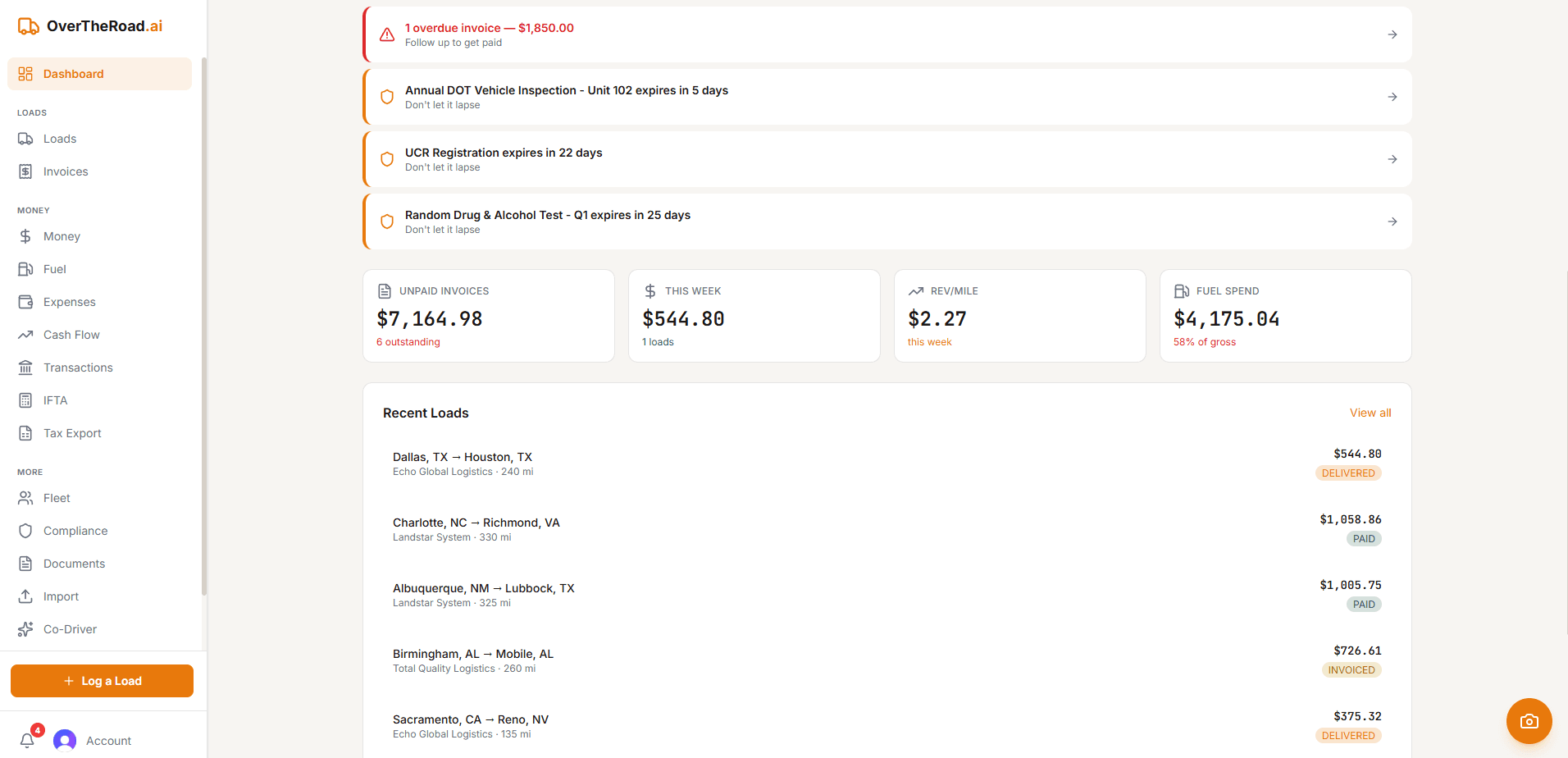
You need a system for tracking loads, sending invoices, filing IFTA, managing compliance deadlines, and tracking expenses from day one. Many new carriers try to do this with spreadsheets — and fall behind within the first quarter.
The key systems you need to have in place:
- Load tracking: Where each load stands — booked, picked up, delivered, invoiced, paid
- Invoicing: Professional invoices sent to brokers with rate con and BOL attached
- Expense tracking: Every fuel purchase, maintenance bill, and toll categorized
- Compliance calendar: Every CDL, medical card, insurance, and permit expiration tracked
- IFTA prep: Miles and fuel by state, ready for quarterly filing
9. Additional Items
- Drug & alcohol testing program ($50-100 enrollment): Required. Enroll with a DOT-compliant consortium before your first load.
- SCAC code ($69/year): Required by some shippers for EDI and routing. Apply through NMFTA.
- Load boards ($40-150/month): DAT, Truckstop, or similar to find freight.
- Business bank account: Keep business and personal finances separate from day one. This saves massive headaches at tax time.
- Fuel cards: EFS, Comdata, or another major fleet card for fuel discounts (typically 3–8 cents/gallon at the pump) and state-by-state IFTA tracking.
Estimated Startup Costs Summary
| Item | Estimated Cost |
|---|---|
| Insurance (first year) | $8,000–$15,000 |
| IRP Registration | $1,500–$3,500 |
| Form 2290 (HVUT) | $550 |
| UCR (1-2 vehicles, 2026) | $46 |
| BOC-3 | $30–$75 |
| Drug testing enrollment | $50–$100 |
| ELD (first month) | $25–$50 |
| Load board (first month) | $40–$150 |
| Total (first month/quarter) | $10,000–$19,500 |
Week-by-Week Timeline
Here's how the process actually plays out on the calendar, assuming you file everything promptly. The clock that matters most is the 21-day protest period — it starts when FMCSA publishes your application, and nothing you do speeds it up.
| When | What happens |
|---|---|
| Week 0 | File your authority application (OP-1 / URS) with FMCSA. Form your LLC and open the business bank account before this if you want the authority issued to the company. |
| Weeks 1–3 | The 21-day public protest period runs. Use it: get insurance quotes and bind coverage (agent files BMC-91), file the BOC-3, enroll in a drug & alcohol consortium. Insurance underwriting is the slow step — start it day one. |
| Weeks 3–6 | Protest period expires. If BMC-91 and BOC-3 are on file, FMCSA activates the authority — verify it shows ACTIVE on SAFER. Then file UCR, apply for IFTA license + decals, register IRP, e-file Form 2290, install the ELD. |
| First load | Set up broker packets, a load board, and your back office (load tracking, invoicing, expenses). Vet every broker before you haul for them — check authority age and pay history. |
| Months 1–18 | New-entrant monitoring period. The safety audit usually lands inside the first 12 months — keep driver qualification files, HOS records, drug testing, and maintenance records audit-ready from day one. |
Pro Tip
The most common self-inflicted delay: waiting until the protest period ends to start insurance shopping. Underwriting a new authority can take 1–2 weeks by itself. Run it in parallel and your authority activates the day the clock runs out.
Common New Authority Mistakes
- Running loads before authority is active. Check your authority status on FMCSA's SAFER system before booking your first load.
- Not shopping insurance. New authority rates vary wildly between agents. Get at least 3 quotes.
- Skipping the drug testing consortium. It's not optional. Get enrolled before your first load.
- No bookkeeping system from day one. Playing catch-up at tax time costs 10x more than staying organized from the start.
- Accepting bad loads. New carriers often take any load offered. Calculate revenue per mile and know your minimum before you book.
Frequently Asked Questions
How much does it cost to start a trucking company?
Budget $10,000–$19,500 for the first month if you already own your truck. That covers insurance down payment, IRP, Form 2290, UCR, BOC-3, drug testing enrollment, ELD, and a load board subscription. Insurance is the biggest line item — $8,000–$15,000/year for the first year before rates drop with clean-record history.
How long does it take to get trucking authority?
FMCSA processing takes 4–6 weeks from the date you file your MC application. Authority typically goes active 21 days after FMCSA posts it in the Federal Register — assuming your BOC-3 and insurance filings are on record by then. Incomplete filings restart the clock, which is the single biggest cause of delayed authority activation.
What do I need to do after getting my MC number?
In order: file insurance (BMC-91), file BOC-3 process agent, register for IRP, file UCR, pay Form 2290 HVUT, get an ELD, enroll in a drug testing consortium, apply for IFTA decals. None of this is optional — missing any single item means your authority either doesn't activate or gets revoked within the first 90 days.
Do I need a DBA or LLC to start trucking?
Not required by FMCSA — your authority can be under your personal name. But an LLC protects your personal assets from business liability and is strongly recommended. Most states charge $50–$500 to register an LLC. Do it before you file for authority so your MC/DOT number is issued to the LLC, not to you personally.
What is the New Entrant Safety Audit?
FMCSA audits every new motor carrier during the ~18-month new-entrant monitoring period after you activate your authority — the audit is typically conducted within the first 12 months. They review your driver qualification files, HOS records, drug testing program, maintenance records, and insurance. Pass and you get unconditional authority; fail and you get a timeline to fix issues or face revocation. Prepare for it from day one — don't wait for the notice.
What should be on a trucking authority checklist?
Eleven items: primary liability + cargo insurance (BMC-91 filing), BOC-3 process agent, the 21-day protest period cleared with authority showing ACTIVE on SAFER, UCR registration, IFTA license and decals, IRP apportioned plate, Form 2290 heavy vehicle use tax, an FMCSA-registered ELD, drug & alcohol consortium enrollment, a business bank account, and a working back office for loads, invoices, expenses, and compliance dates. The interactive checklist at the top of this page covers all eleven and saves your progress.
Can I still get an MC number?
No. As of October 1, 2025, FMCSA stopped issuing new MC numbers — new carriers get a USDOT number only, and that single number now serves as your operating authority identifier. Existing MC numbers issued before that date remain valid, which is why you still see them on older brokers and carriers. Everything on this checklist applies the same way; only the number on your paperwork changed.
What insurance do I need for a new trucking authority?
Primary liability at $750,000 minimum for general freight ($1M is what most brokers actually want to see, and hazmat runs $1M–$5M), plus cargo coverage — typically $100,000. Your agent files the BMC-91 with FMCSA; the authority cannot activate without it. Physical damage coverage on the truck isn't federally required but your lender will require it. First-year cost for a new authority with a clean record typically lands between $8,000 and $15,000.
How OverTheRoad.AI handles this
Your entire back office, set up in 10 minutes
- Enter your DOT number — OverTheRoad.AI pulls your carrier info automatically
- Connect your Samsara ELD in 2 clicks — loads, miles, and trips sync
- Link your fuel card — fuel purchases categorized by state automatically
- Compliance calendar pre-loaded with your renewal dates
Related Guides
Want your real cost per mile in 3 minutes?
Drop a settlement or rate con — our free analyzer pulls CPM, RPM, broker margin, and IFTA prep.