MC Number vs DOT Number: What's the Difference?
Every new trucking business has to deal with two federal numbers from FMCSA: a USDOT number and an MC number. They sound similar, they're often issued together, and the FMCSA website is not famous for clarity. Here's the short version — and the details that actually matter when you're filling out the application.
Last updated: 6 min readBy OverTheRoad.AI Team
Update (effective October 1, 2025): FMCSA no longer issues new MC numbers.
As of October 1, 2025, FMCSA stopped issuing new MC, MX, and FF numbers. New applicants now receive USDOT-number-only identification — the USDOT number is the sole federal identifier for new registrations. Existing MC numbers remain valid and may still appear on older records, and brokers may still reference them. The MC-vs-DOT explanation below reflects the pre-October-2025 system that still governs existing carriers; it's useful context, but new applicants won't be assigned an MC number.
MC vs DOT: who needs what
| USDOT number | Required for: any interstate CMV over 10,001 lbs GVW, hazmat carriers, vehicles carrying 9+ passengers for hire, and most intrastate CMVs over 26,001 lbs GVW |
|---|---|
| MC number | Required for: for-hire transport of non-exempt freight across state lines (most over-the-road owner-operators) |
| Application fee | $300 for MC authority (USDOT alone is free) |
| Vetting period | 21 days from grant of MC authority before the carrier can legally operate |
| When DOT-only is enough | Private carriers hauling their own cargo; some intrastate-only operations; certain exempt commodities |
| Insurance filing required | Yes — BMC-91 (or BMC-34) for MC authority, before authority becomes active |
| What brokers check | MC number, DOT number, FMCSA safety rating, and on-file insurance via SAFER |
The 60-Second Answer
- USDOT number — identifies you as a commercial motor carrier to FMCSA. Required for almost any truck over 10,001 lbs GVWR operating in interstate commerce. Free to obtain.
- MC number (Motor Carrier) — grants operating authority to transport regulated commodities for hire across state lines. Required if you're hauling freight for payment on behalf of others. Costs $300 one-time.
In simple terms: DOT says you exist; MC says you're allowed to haul for hire. Most owner-operators need both. A few situations require only one.
What a USDOT Number Is
A USDOT number is a federal tracking number for any business operating commercial motor vehicles. It's used by FMCSA to log your inspection history, accidents, audits, and CSA scores. Every truck you operate displays the number on the side of the vehicle.
You need a USDOT number if you operate a vehicle that:
- Has a gross vehicle weight rating (GVWR) of 10,001 lbs or more, AND
- Crosses state lines (interstate commerce), OR
- Transports hazardous materials in quantities requiring placards, OR
- Transports 9–15 passengers including the driver for compensation, or 16+ including the driver regardless of compensation, across state lines
Some states also require a USDOT number for intrastate-only carriers. Check your base state's requirements before assuming you're exempt.
What an MC Number Is
An MC number ("Motor Carrier" operating authority) is FMCSA's permission slip to operate for hirecarrying regulated commodities across state lines. Regulated commodities include almost all general freight you'd haul on a rate confirmation — dry goods, reefer freight, flatbed, auto hauling, etc.
You need an MC number if you:
- Operate as a for-hire carrier (getting paid to transport someone else's freight), AND
- Cross state lines, AND
- Haul regulated commodities (which covers nearly all freight)
Private carriers hauling their own company's goodsdon't need an MC number (they still need DOT). Intrastate-only carriers don't need an MC number from FMCSA, though they likely need a state-issued equivalent.
When You Need One but Not the Other
| Situation | DOT | MC |
|---|---|---|
| Owner-operator hauling general freight interstate | Yes | Yes |
| Private fleet hauling own goods (e.g., Walmart trucks) | Yes | No |
| Intrastate-only hotshot (one state, no federal freight) | Sometimes | No |
| Broker only (no trucks, arranging freight) | No | Yes (Broker MC) |
| Hauling exempt commodities only (unprocessed produce, livestock) | Yes | Sometimes |
Pro Tip
Most brokers won't book a load with a carrier that has a DOT number but no MC number, even if your freight technically qualifies as exempt. Operating with MC authority opens up 95%+ of the broker market.
How to Apply
Both numbers are applied for through the same FMCSA Unified Registration System (URS) at fmcsa.dot.gov. The process:
- Create an FMCSA account. You'll need your LLC's EIN (or your SSN if sole prop).
- Complete the registration form. You'll declare your operation type (for-hire carrier, private carrier, broker, etc.), the cargo classes you'll haul, number of vehicles, and number of drivers.
- Pay the $300 filing fee (only if applying for MC authority — the DOT number by itself is free).
- Wait for the Federal Register posting. Your MC authority gets posted for 21 days. During that window, you file insurance (BMC-91) and BOC-3.
- Authority activates. If insurance and BOC-3 are on file at the end of the 21-day window, your authority goes active. Total timeline: 4–6 weeks.
What Brokers Actually Check
When a broker sets you up for a load, they run your numbers against FMCSA's SAFER system and typically a carrier monitoring service (RMIS, MyCarrierPackets, Carrier411, etc.). They look at:
- Authority status: Active or inactive. Inactive = no load.
- Operating authority granted date: Some brokers won't work with carriers under 6 months old without extra paperwork.
- Insurance on file: Primary liability (BMC-91) and cargo. If either has lapsed, no load.
- Safety rating: Satisfactory, Conditional, Unsatisfactory, or unrated. Most brokers accept Satisfactory and unrated; Conditional often triggers extra scrutiny.
- Out-of-service history and crash data: Too many recent OOS orders and you'll get screened out.
The public SAFER snapshot at safer.fmcsa.dot.gov shows all this for any carrier. Before your first load, pull your own SAFER record and make sure it looks right — including the legal name, DBA, physical address, and authority type.
Keeping Your Numbers in Good Standing
- MCS-150 update (biennial): Every 2 years you must file an MCS-150 update with FMCSA confirming your information. Miss it and FMCSA can deactivate your USDOT number.
- Insurance filings current: Insurance lapses automatically revoke MC authority. Re-filing to reactivate is slow — avoid it.
- UCR annual: about $46/year for 0–2 vehicles (the fee is set annually). Keeps your interstate authority clean across UCR-member states.
- BOC-3 on file: Set once, usually stays active, but verify once a year through your service provider.
How OverTheRoad.AI handles this
Keep MC and DOT upkeep off your worry list
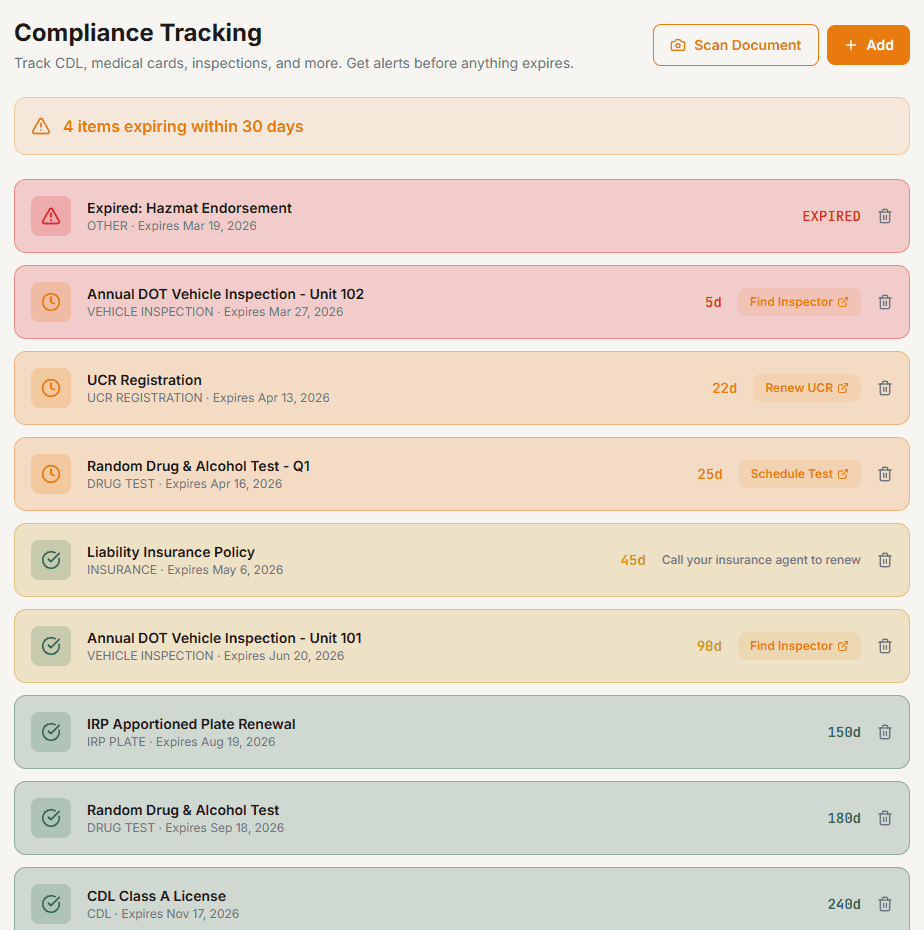
- Tracks your MCS-150 biennial update so the deadline never slips and your USDOT number stays active
- Flags insurance filings before they lapse — a lapse automatically revokes MC authority, and re-filing is slow
- Reminds you when the annual UCR renewal window opens so your interstate authority stays clean
Frequently Asked Questions
Do I need both an MC number and a DOT number?
Most owner-operators need both. If you're hauling general freight for hire across state lines — which is what almost everyone does — you need a DOT number to be registered as a commercial carrier and an MC number for the operating authority to haul for hire. Private carriers (hauling their own goods) and some intrastate-only carriers may only need a DOT number.
How much does it cost to get MC and DOT numbers?
The USDOT number is free. The MC number costs $300 as a one-time FMCSA filing fee. There's no renewal fee on either, but you'll pay about $46/year for UCR (the fee is adjusted annually) to stay in good standing on interstate authority. Some third-party services charge $500–$1,500 to file the paperwork for you — you don't need them; the FMCSA online application is self-service.
How long does it take to get an MC number?
4–6 weeks from application to active authority. FMCSA processes the initial filing in 1–2 weeks, then your authority is posted in the Federal Register for 21 days. Authority goes active at the end of the 21-day window if insurance (BMC-91) and BOC-3 are on file. Incomplete filings restart the clock.
Can I start hauling before my MC number is active?
No. Operating without active authority is a violation that can result in civil penalties into the five figures per violation (adjusted annually), and no broker will book a load with an inactive carrier. Check safer.fmcsa.dot.gov or the FMCSA public registry to confirm your authority status before your first load.
Do hotshot trucks need MC numbers?
If the hotshot crosses state lines and hauls for hire (which is almost all hotshot operations), yes. The GVWR threshold for needing a DOT number is 10,001 lbs, and any 1-ton pickup with a loaded trailer blows past that. Hotshots running intrastate-only may only need state authority, not federal.
What's the difference between MC and MX numbers?
MC is for US-domiciled carriers. MX is for Mexican-domiciled carriers authorized to operate in the US. As a US owner-operator, you'll have an MC number. MX is only relevant if you're a carrier based in Mexico crossing into US commerce.
Related Guides
Want your real cost per mile in 3 minutes?
Drop a settlement or rate con — our free analyzer pulls CPM, RPM, broker margin, and IFTA prep.