
CSA Score Explained (And How to Improve Yours)
Your CSA score is the number FMCSA and brokers use to decide whether you're a safe bet. A bad score can get your loads refused, your insurance quotes doubled, and your authority investigated. A good one is mostly invisible — until you lose it. Here's what your score actually measures, how it's calculated, and the concrete steps to bring a bad one down.
Last updated: 11 min readBy OverTheRoad.AI Team
The 7 CSA BASICs and intervention thresholds
| Unsafe Driving BASIC | Speeding, lane changes, reckless. Threshold: 65% (Hazmat 60%, Passenger 50%) |
|---|---|
| Hours-of-Service BASIC | ELD logs, HOS violations. Threshold: 65% (Hazmat 60%, Passenger 50%) |
| Driver Fitness BASIC | CDL, medical card, training. Threshold: 80% (Hazmat 75%, Passenger 65%) |
| Controlled Substances/Alcohol BASIC | DOT testing violations. Threshold: 80% (Hazmat 75%, Passenger 65%) |
| Vehicle Maintenance BASIC | Brakes, lights, tires, defects. Threshold: 80% (Hazmat 75%, Passenger 65%) |
| Hazardous Materials Compliance BASIC | If hauling hazmat. Threshold: 80% |
| Crash Indicator BASIC | A crash rate normalized by fleet size (average power units). Threshold: 65% (Hazmat 60%, Passenger 50%) |
| Data window | Rolling 24 months |
| How to look up | FMCSA Safety Measurement System (SMS) using your USDOT number |
What CSA Actually Is
CSA stands for "Compliance, Safety, Accountability" — FMCSA's program for measuring motor carrier safety. It's not a single number. It's a collection of category-specific percentile rankings (the "BASICs") based on your 24-month history of inspections, violations, and crashes.
Your CSA data is tracked against every other carrier in your safety-event peer group. You're scored in percentiles — a 75th percentile means 75% of similar carriers have fewer violations in that category. Higher percentile = worse score. The thresholds that trigger FMCSA intervention sit at 65–85% depending on BASIC and carrier type.
One caveat: FMCSA has proposed changes to the Safety Measurement System (SMS) methodology behind CSA, so specific BASIC names, thresholds, and scoring details may shift if those revisions take effect. Treat the figures here as the current framework, not a permanently settled one.
The 7 BASICs — What Each One Measures
| BASIC | What It Measures | Intervention Threshold |
|---|---|---|
| Unsafe Driving | Speeding, reckless driving, improper lane changes, seat belts | 65% |
| Hours of Service (HOS) Compliance | ELD violations, driving over 11-hour limit, 14-hour rule, false logs | 65% |
| Driver Fitness | CDL/medical card expiration, driver qualification file gaps | 80% |
| Controlled Substances / Alcohol | Positive drug tests, DUI, refusal to test, consortium gaps | 80% |
| Vehicle Maintenance | Brake issues, tire defects, lights, load securement, missing inspection sticker | 80% |
| Hazardous Materials Compliance | Placarding, shipping papers, loading/unloading (only if you haul hazmat) | 80% |
| Crash Indicator | DOT-recordable crashes, expressed as a crash rate normalized by fleet size (average power units) | 65% (not publicly displayed) |
The first 5 are public on FMCSA's SAFER system — any broker or shipper can look them up. Crash Indicator and Hazmat Compliance (for non-hazmat carriers) are kept internal. That doesn't mean they don't matter — FMCSA still uses them for intervention decisions.
How Scores Are Calculated
Every roadside inspection, violation, and crash goes into the system with a severity weight (1–10, with 10 being most serious) and a time weight (events within the last 6 months count 3x; 6–12 months count 2x; 12–24 months count 1x). Older than 24 months and they age off.
The raw score is calculated per BASIC, then normalized against your safety-event group (carriers with similar exposure — miles, inspections, fleet size). The final number is a percentile ranking against peers.
Key implication: one bad event in a small-fleet operation can spike your percentile badly. If your peer group is "carriers with 5–10 inspections in 24 months," one out-of-service brake violation can push you into the 90th percentile overnight. Large carriers can absorb individual events; small OOs can't.
Who Actually Looks at Your CSA Score
- Brokers and shippers. Most broker onboarding systems (RMIS, Highway, MyCarrierPackets) auto-pull your FMCSA snapshot. Scores over certain thresholds trigger automatic load refusal or extra paperwork.
- Insurance carriers. Your CSA profile factors directly into your renewal rates. Carriers with repeated Unsafe Driving or Vehicle Maintenance flags typically see materially higher liability-coverage quotes — and in some cases lose their preferred-market carrier altogether and get pushed to non-standard underwriters.
- FMCSA itself. Crossing intervention thresholds triggers compliance reviews, warning letters, and eventually on-site audits.
- Potential buyers of your business. If you ever sell the authority, a bad CSA profile kills the deal.
How to Actually Improve a Bad CSA Score
The mechanism is simple but slow: stop generating new violations and wait for old ones to age off. But "stop generating" requires targeting specific root causes. Here's the playbook:
- Address vehicle maintenance first. Brakes and tires drive the most out-of-service orders. Walk around your truck with a maintenance checklist before every load. If you have one truck and can't self-inspect competently, pay a shop $100 for a monthly professional walk-around.
- Fix your pre-trip and post-trip inspections (DVIR).A proper DVIR documented every day is both a CSA data point and a reality check. "No defects noted" every day on a 2015 truck is a red flag.
- Nail your HOS. ELD violations are a top-3 violation category. Don't run a minute over 11 or 14. Don't edit logs. Don't have "unassigned driving" on your ELD (that's someone driving without logging in).
- Keep your driver qualification file clean.Medical card current, drug testing consortium active, MVR pulled annually. Driver Fitness BASIC is one of the easiest to get right with discipline.
- Challenge bad data via DataQs. If a violation on your record is factually wrong or assigned to you in error, you can dispute it through FMCSA's DataQs system. Well- documented disputes (photos, maintenance records, ELD timestamps) have a meaningful success rate; weak ones usually fail. Aggregate outcomes are published in FMCSA annual reports.
- Time is on your side. After 24 months, every violation ages off entirely. Even bad histories can recover — it just takes the full 24 months of clean operation to completely rebuild.
How OverTheRoad.AI handles this
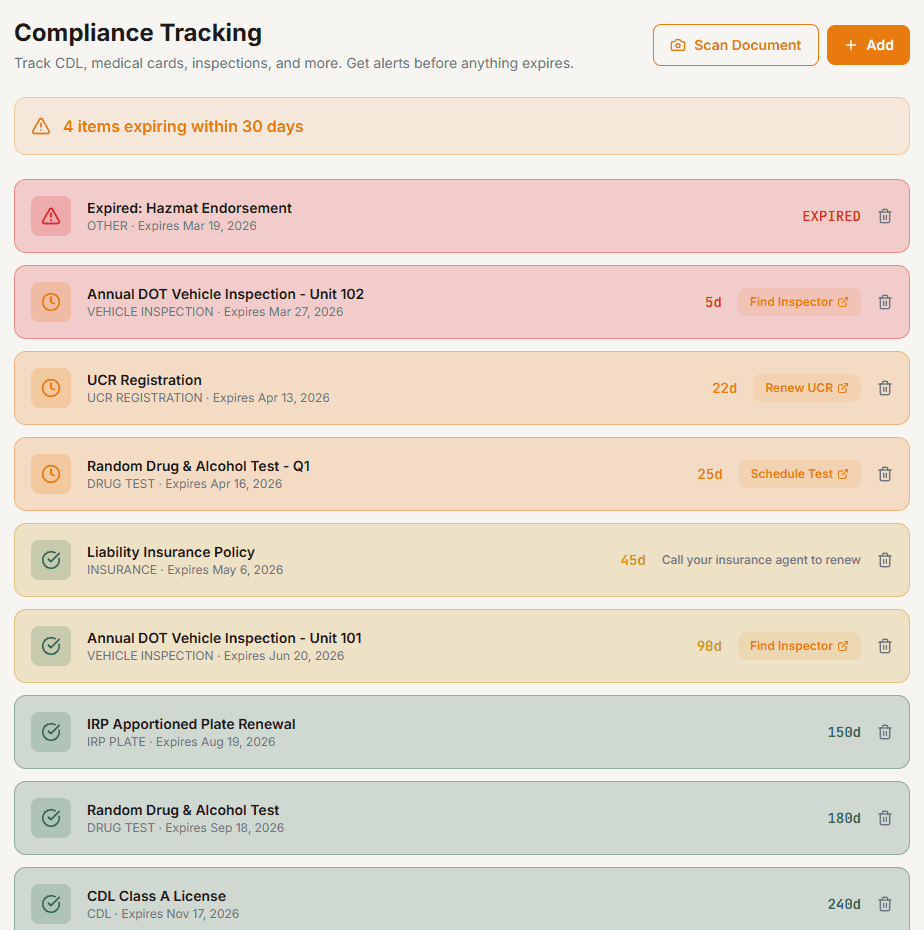
Stay ahead of the deadlines that drive CSA violations
- Medical card, CDL, DOT inspection, insurance, and permit renewals tracked on one compliance calendar
- Color-coded timelines: green (current), yellow (expiring soon), red (expired) — obvious at a glance
- Every document scanned and archived so audit-ready records are never 'in a folder somewhere'
- Maintenance log for brake adjustments, tire rotations, and DVIRs — the paper trail that kills 'out-of-service' surprises
Common Misconceptions About CSA
- "My score is fine because it's under 50%." Percentiles don't work like averages. A 50% in Unsafe Driving means half of similar carriers have fewer violations than you — already below average. Aim for under 30% in every BASIC, not under 50%.
- "I only got warned, so it doesn't count." Warnings from an inspection still get logged as violations, even if no citation was issued. The data matters, not the fine.
- "My driver made the mistake, not me."The violation goes on the carrier's CSA score, not just the driver. For one-truck OOs this is the same thing, but it matters if you're hiring drivers.
- "Crashes where I wasn't at fault won't count." All DOT-recordable crashes factor into Crash Indicator regardless of fault. There's a pending FMCSA policy to remove non-preventable crashes, but it's not fully implemented — document everything defensively.
How to Check Your Own CSA Score
Your public SAFER snapshot is free at safer.fmcsa.dot.gov. Enter your USDOT or MC number. You'll see:
- Company identification (name, address, DOT/MC numbers)
- Inspection and crash summary (past 24 months)
- Safety rating (Satisfactory, Conditional, Unsatisfactory, or unrated)
For the full BASIC percentile breakdown, you need to log into FMCSA's Portal (fmcsa.dot.gov/registration) using your PIN. That's the only way to see the intervention-threshold percentiles directly.
Pro Tip
Pull your own SAFER record quarterly. If something is wrong, catch it early — disputed data takes weeks to resolve and can cost you loads in the meantime.
Frequently Asked Questions
What is a good CSA score for a trucking company?
Aim for percentile rankings under 30% in every BASIC. Above 50% you're below average; above the intervention threshold (65–80% depending on BASIC) FMCSA may intervene and many brokers will refuse loads. A "clean" carrier typically has every BASIC in the 5th–25th percentile range.
How long do CSA violations stay on my record?
24 months from the violation date. Violations within the last 6 months count 3x (most weight), 6–12 months count 2x, 12–24 months count 1x. After 24 months they age off entirely. A single bad event ages off fully after 2 years of clean operation.
How often is CSA data updated?
Roughly monthly. FMCSA refreshes the SMS data on a regular monthly cycle. New inspections and violations typically appear in your record within 30–60 days of the event.
Can I dispute a CSA violation?
Yes — through FMCSA's DataQs system (dataqs.fmcsa.dot.gov). You file a Request for Data Review with supporting documentation. Timelines are typically 30–90 days. Strong documentation (photos, maintenance records, witness statements) dramatically improves your odds; unsubstantiated disputes usually fail.
Does CSA affect my insurance rates?
Yes, substantially. Insurance carriers pull CSA data as part of their underwriting. A carrier flagged in Unsafe Driving or Vehicle Maintenance typically sees materially higher renewal quotes, and in some cases loses their preferred-market carrier and has to move to non-standard underwriters. Clean CSA is one of the highest-ROI compliance investments an owner-operator can make.
What's the difference between CSA score and safety rating?
CSA score is the continuously-updated percentile ranking across 7 BASICs. Safety rating is a discrete rating (Satisfactory, Conditional, Unsatisfactory, or unrated) typically issued after a compliance review or on-site audit. Most small carriers remain "unrated" unless they trigger an FMCSA review. Your CSA score is what most brokers actually check — the safety rating is mostly a pass/fail input.
Related Guides
Want your real cost per mile in 3 minutes?
Drop a settlement or rate con — our free analyzer pulls CPM, RPM, broker margin, and IFTA prep.