Cash Flow Management for Truckers
You can be profitable on paper and still run out of cash. The gap between delivering a load and getting paid is where most owner-operators feel the squeeze. Here's how to manage it.
Last updated: 10 min readBy OverTheRoad.AI Team
Solo owner-operator cash-flow benchmarks
| Average broker payment | 30 days from invoice (some 15, some 45) |
|---|---|
| Typical fixed monthly costs | $3,500 - $5,000 (truck + insurance + admin) |
| Typical fuel cost (10,000 mi/mo) | about $6,500 - $8,500 at $4-$5/gal, 6 mpg |
| Recommended operating reserve | 30 days minimum (60 days for new authorities) |
| QuickPay fee range | 1-3% of rate for 1-2 day payment |
| Factoring fee (recourse) | 2-3% for 1-3 day payment |
| Factoring fee (non-recourse) | 3-5% for 1-3 day payment, factor takes credit risk |
| Quarterly tax reserve | 25-30% of net income |
Why Cash Flow Is Different From Profit
Profit is what you earn over time. Cash flow is whether you have enough money in your account right now to fill the tank, make your truck payment, and cover insurance. You can be profitable for the quarter and still bounce a payment if your receivables are slow.
The average broker pays in 30 days. Some pay in 45. Your fuel bill, truck payment, and insurance don't wait.
Know Your Fixed Monthly Costs
Start by listing every expense that hits your account whether you run loads or not:
- Truck payment or lease ($1,500–$2,800/month)
- Insurance premiums ($700–$1,500/month)
- ELD subscription ($25–$50/month)
- Phone bill ($50–$100/month)
- Parking / yard fees (if applicable)
- Load board subscriptions ($40–$150/month)
- Accounting / bookkeeping ($50–$150/month)
This is your baseline. For most solo operators, fixed costs run $3,500–$5,000/month. You need at least this much cash coming in every month before you break even.
Variable Costs to Watch
- Fuel: Fluctuates with diesel prices and miles driven. Many operators aim to keep fuel around 30-40% of gross revenue.
- Maintenance: Average $15,000/year for a well-maintained truck. Breakdowns are unpredictable — keep a reserve.
- Tolls: Can add up quickly on certain lanes (Northeast corridor: $200-$400 per round trip).
- Lumper fees: Out-of-pocket at some receivers. May or may not be reimbursed.
The 14-Day Cash Forecast
Look two weeks ahead. Add up the cash you expect to receive (pending settlements, outstanding invoices) and subtract the expenses you know are coming (truck payment on the 15th, insurance on the 1st, estimated fuel spend).
If the number goes negative at any point in the next 14 days, you have a cash flow problem — and you need to either accelerate receivables (factoring, quick-pay) or delay a discretionary expense.
Pro Tip
Run this forecast every Monday morning. It takes 5 minutes and prevents the panic of discovering on Thursday that you can't cover Friday's truck payment.
Factoring: When It Makes Sense
Factoring companies buy your invoices at a discount (typically 2-5%) and pay you within 24-48 hours. It's expensive money, but it solves the timing problem. Factoring makes sense when:
- You're new and don't have cash reserves built up
- A broker pays Net 45+ and you need the cash sooner
- You're growing and need working capital to fuel more loads
It doesn't make sense if you have cash reserves and your brokers pay in a reasonable window. On a $3,000 load, a 3% factoring fee costs $90. Over 100 loads/year, that's $9,000 in fees.
Build a Cash Reserve
Many operators aim to keep at least 30 days of fixed expenses in reserve — 60 days is safer for new authorities. For a solo owner-operator, that often works out to somewhere around $10,000–$20,000. That's your buffer against slow-paying brokers, unexpected repairs, and downtime. It takes time to build, but it removes the stress of living settlement to settlement.
Without cash flow visibility
- Check bank account and hope for the best
- Surprised by low balance after truck payment hits
- No idea when outstanding invoices will be paid
- Reactive — find out about problems after they happen
- Factor every invoice because you can't risk waiting
With OverTheRoad.AI cash flow tools
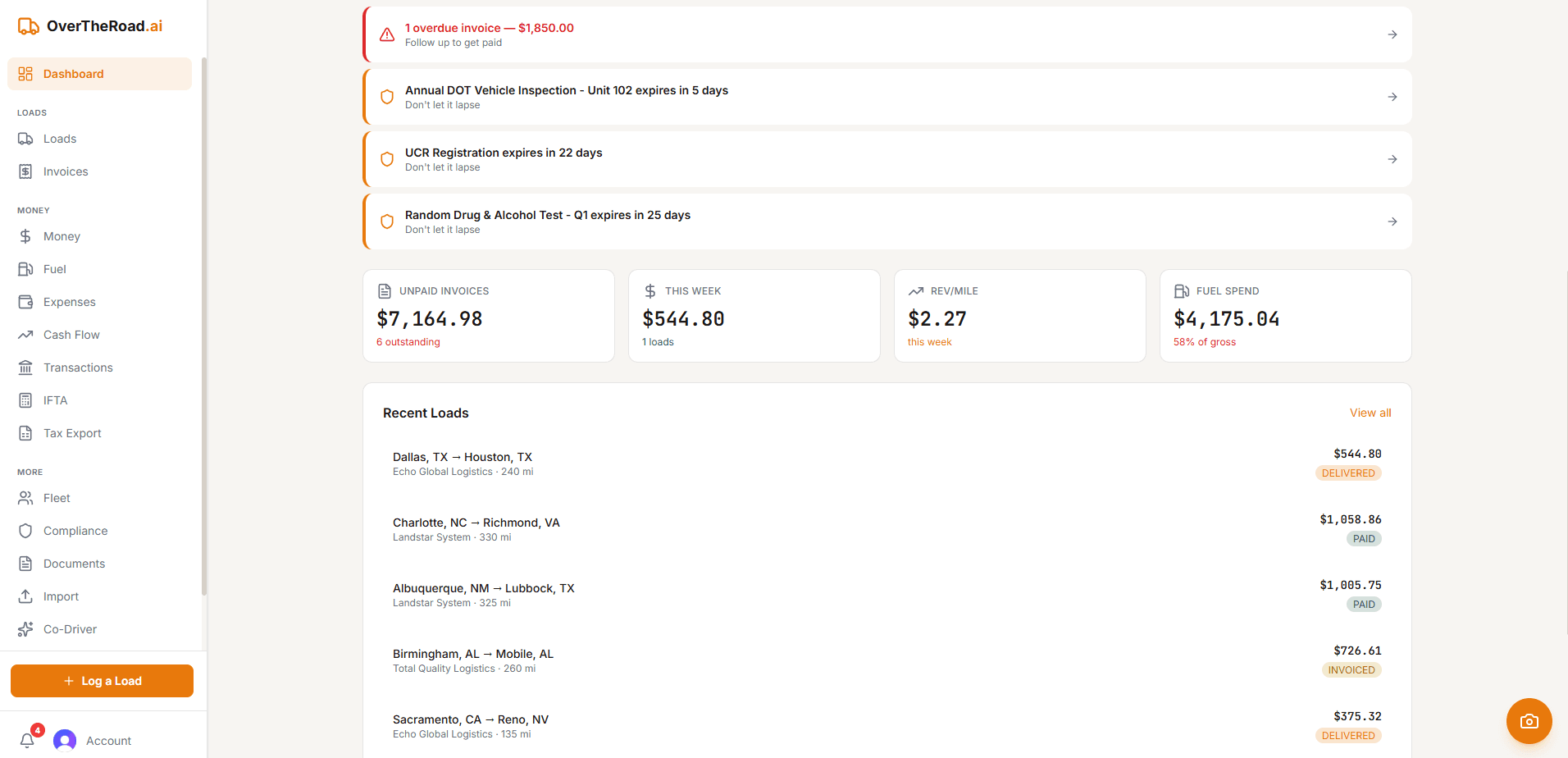
- 14-day cash flow projection based on real receivables
- Low-balance alerts before you run short — not after
- Invoice payment tracking shows what's coming and when
- Proactive — adjust load booking or factor selectively
- Only factor when the math makes sense
How OverTheRoad.AI handles this
Know where you stand before you run short
- 14-day cash flow projection based on actual receivables and upcoming expenses
- Low-balance alerts hit your phone before you overdraft
- Invoice aging shows which brokers are overdue
- Bank sync keeps your balance and transactions current automatically
Related Guides
Want your real cost per mile in 3 minutes?
Drop a settlement or rate con — our free analyzer pulls CPM, RPM, broker margin, and IFTA prep.