
Best Trucking Factoring Companies (2026)
Factoring is the fastest way an owner-operator can close the 30–45 day gap between delivering a load and getting paid. It's also one of the easiest places to lose $10,000+ a year in fees you didn't realize you were paying. Here's an honest look at the top trucking factoring companies, what they actually cost, and when factoring makes sense versus when it doesn't.
Last updated: 13 min readBy OverTheRoad.AI Team
Factoring economics at a glance
| Recourse factoring fee range | 1.5-3% of invoice (industry typical) |
|---|---|
| Non-recourse factoring fee range | 3-5% of invoice (industry typical) |
| Payment speed | 1-3 business days from invoice + POD submission |
| QuickPay fee range (broker-direct) | 1-3% of invoice for 1-2 day payment |
| Typical contract length | 6-24 months (look for month-to-month options) |
| Typical credit-check fee | $5-$15 per broker (some factors charge for new-broker checks) |
| Termination fee risk | Up to 6 months of remaining contract value, depending on terms |
| When to factor | When the cost of the cash-flow gap (missed loads, late fees, fuel-card declines) exceeds the factoring fee |
How Factoring Actually Works
You deliver a load, send the signed BOL and invoice to your factor instead of the broker. The factor advances 94–97% of the invoice to your bank account within 24 hours. The factor then collects the full invoice from the broker over the next 30–45 days. The difference between what they paid you and what they collect is their fee.
Key concepts:
- Recourse factoring: If the broker doesn't pay, you buy the invoice back from the factor. Cheaper (typically 1.5–3%), but you carry the credit risk.
- Non-recourse factoring: The factor eats the loss if the broker doesn't pay (usually only for credit reasons). More expensive (3–5%), but your risk is capped.
- Notice of Assignment (NOA): Legal document the factor sends to your brokers telling them to pay the factor directly. Mandatory on factored loads.
- Reserve / advance rate: The percentage advanced upfront (94–97%); the remaining 3–6% is released when the invoice is fully paid, minus the factoring fee.
What to Look For When Comparing Factors
Rather than rank specific companies — fee quotes change monthly and depend heavily on your volume, broker mix, and negotiation — here's the evaluation framework that separates a good factor relationship from an expensive one.
| What to Ask For | Industry-Typical Range |
|---|---|
| Recourse base fee | 1.5–3% |
| Non-recourse base fee | 3–5% |
| Advance rate (% paid up front) | 94–97% |
| ACH fee per funding | $0–$20 |
| Same-day funding fee | $0–$50 |
| Minimum monthly volume | $0–$25,000 (watch for penalty) |
| Termination / buyout fee | 0–6% of monthly volume |
| Contract length | Month-to-month to 12 months |
Major players in the US trucking factoring market include Triumph Business Capital, RTS Financial, Apex Capital, eCapital, TAFS, OTR Capital (no affiliation with OverTheRoad.AI), Love's Financial, TBS Factoring, and Porter Capital — among others. Get current quotes from at least three, and ask each one to put every fee from the table above in writing. The base rate is typically only ~60% of what you'll actually pay once ACH, same-day funding, and minimums are layered on.
Pro Tip
Never sign a factor contract without asking for the full fee schedule in writing: base rate, ACH fee, same-day funding fee, paper-invoice fee, NOA fee, minimum monthly fee, and termination fee. Industry ranges move over time and by volume tier — always compare live quotes, not last year's numbers.
The Hidden Fees That Eat Your Margin
- Same-day / expedited funding fee: $15–$50 per batch for money hitting your account the same day you submit (vs. next business day).
- ACH fee: $10–$20 per funding. If you fund daily, that's $200–$400/month on top of the base rate.
- Minimum monthly volume fee: Some factors charge a flat fee if your invoices drop below $15,000–$25,000/month.
- Termination / buyout fee: Early termination on a term contract can be 3–6% of your average monthly volume. This is the fee that locks drivers into bad relationships.
- Paper invoice fee: $5–$15 for every invoice submitted as a paper scan instead of digital. Adds up if your process is paperwork-heavy.
- Credit check fee: Some factors charge $10–$25 per broker credit check if you're vetting a new broker.
Recourse vs Non-Recourse: Which One to Pick
Recourse factoring is the default for most small operations. You save 1–2 percentage points, and most brokers in the top 500 pay reliably enough that the risk is manageable. Switch to non-recourse only if:
- You're hauling for a small or unfamiliar broker with no credit history
- A single unpaid invoice would create real cash-flow harm (you don't have $5,000+ buffer to absorb it)
- You're hauling high-value loads ($10,000+) where one non-payment is a serious event
Non-recourse doesn't protect you from allnon-payment — only credit-based non-payment. If the broker disputes the load (shortage claim, late delivery, rate disagreement), the factor still pushes the invoice back to you. Read the carve-outs carefully.
When NOT to Factor
Factoring costs real money. On a $3,000 invoice at 3%, that's $90. Do that on 100 loads a year and you've paid $9,000 to shorten your DSO from 35 days to 1 day. Sometimes that's worth it. Often it isn't.
You probably shouldn't factor if:
- You have 30+ days of operating cash in the bank. Floating the 30-day wait at zero cost beats paying 2–3% every time.
- Most of your freight comes from the large national brokers with Net 15–30 payment histories.
- You can use the broker's QuickPay option selectively for loads where you need cash faster. QuickPay at 2% on a $3,000 load costs $60 — same ballpark as factoring but without the monthly minimums, NOA paperwork, or term contracts.
- You're only waiting on 1–2 loads at a time. Factoring makes sense when you have 10+ invoices out at once — the per-load fee is dwarfed by the cumulative cash flow benefit. On low load volume, it's overkill.
The Smarter Way to Think About Factoring
Most owner-operators factor every single load as a default, which is the wrong approach. Factoring is a tool for specific cash-flow situations, not a blanket policy:
- Factor your slow-pay brokers (Net 45+). The 3% fee is cheaper than the alternative of sitting on the invoice for 45 days while fuel bills stack up.
- Don't factor your fast-pay brokers (Net 15–20). You're paying 3% to accelerate cash by 14 days — that's an absurd effective annualized rate.
- Don't factor QuickPay-eligible loadsfrom top brokers. QuickPay at 2% beats factoring at 3% every time.
The catch: to do this well, you need to know your broker pay speed by specific broker relationship. Most carriers rely on gut feel — "I think Acme Logistics pays fast and Pioneer Freight pays slow." That's usually directionally right but doesn't give you the precision to optimize fees.
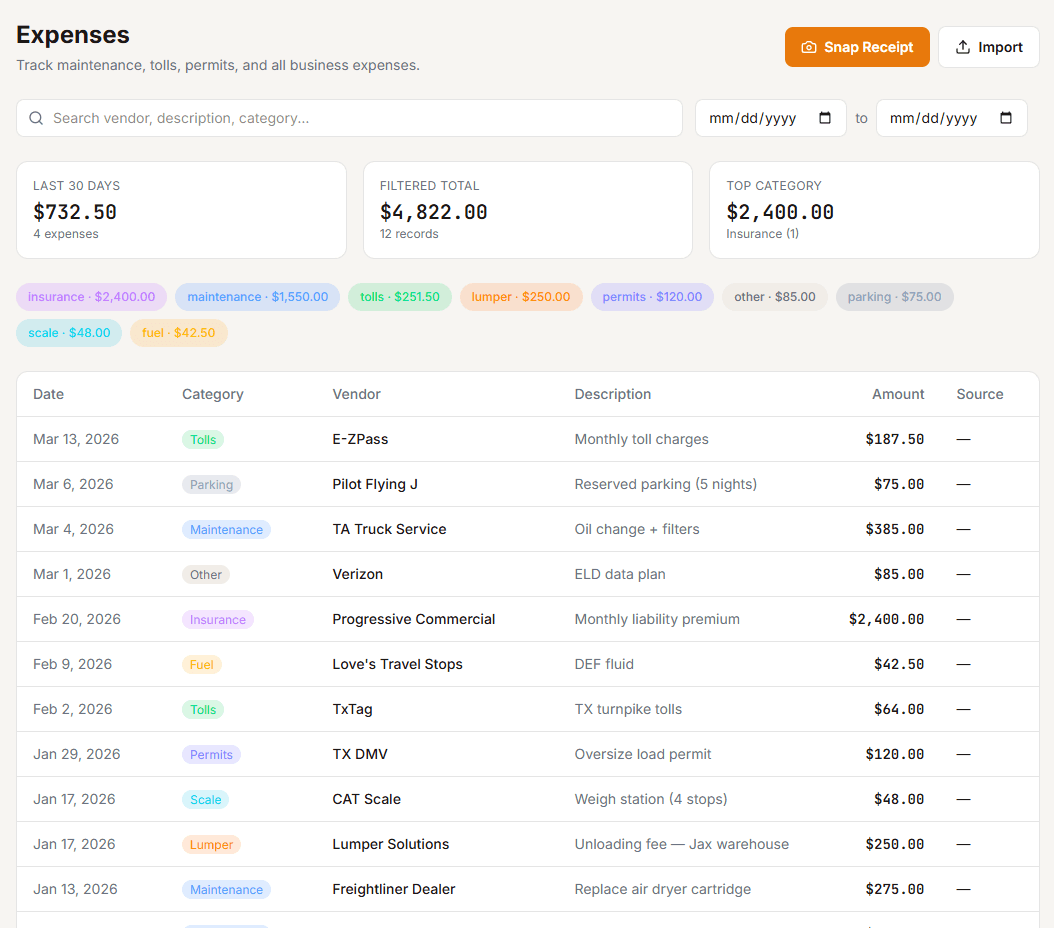
How OverTheRoad.AI handles this
Factor the slow brokers, float the fast ones
- OverTheRoad.AI tracks actual days-to-pay for every broker you work with — not estimates
- Before you book a load, see the broker's average pay speed from your own history
- Factoring alerts tell you which loads are worth factoring and which aren't
- Broker payment reports ready to share with your factor when onboarding
How to Leave a Bad Factor
If you're stuck in a bad factor relationship (high fees, slow fundings, aggressive collections that hurt broker relationships), here's the playbook:
- Read your contract. Termination clause, notice period, buyout fee. Most require 30–60 days written notice.
- Line up the new factor first. Apply, get approved, and confirm the start date. Don't leave yourself with no factor in place.
- Stop submitting new invoices to the old factorthe day you give notice (or as soon as your contract allows). Invoices submitted during the notice window are still their property.
- Coordinate NOA swaps with brokers. Old factor sends a release NOA; new factor sends their NOA. This is the messiest part — expect 1–2 days of confusion per broker.
- Review the final statement. Early termination fees, outstanding reserves, chargebacks. Don't settle without accounting for every line.
Frequently Asked Questions
What's a normal fee for trucking factoring?
1.5–3% of the invoice for recourse factoring, 3–5% for non-recourse. Fees vary by your monthly volume, the broker's credit rating, and whether you pick month-to-month or a term contract. Expect the real effective rate to be 0.5–1 point higher than the advertised rate once ACH fees, same-day funding fees, and minimums are added in.
What's the difference between factoring and QuickPay?
Factoring is a third-party relationship — you send all your invoices to one factor who advances you cash and collects from brokers. QuickPay is a broker-specific option where that individual broker pays you in 1–3 days for a 1–3% fee. Factoring covers all your loads; QuickPay is per-load, per-broker, and only available from larger brokers. Factoring is better for consistent volume; QuickPay is better when you only occasionally need speed.
Do I need factoring to start trucking?
No — but nearly all new carriers sign up with a factor because they don't have 30+ days of operating cash on hand. Factoring bridges the gap while you build up reserves. Once you've got 30–60 days of cash in the bank and stable broker relationships, you can often drop factoring on your fast-pay brokers and save 2–3% on those loads.
Is non-recourse factoring worth the extra cost?
Usually not, if you're primarily hauling for top-500 brokers who pay reliably. The extra 1–2% costs $300–$600/month on typical O/O volume — expensive insurance against an event that rarely happens. Switch to non-recourse if you're hauling for small brokers without credit history or if a single non-payment would seriously damage your cash position.
Can I factor with just one broker or load?
Some factors accept spot factoring (one-off invoices), but fees are higher (4–6%) and approval is slower. For anything beyond occasional one-offs, the economics favor an ongoing relationship with a factor who knows your broker mix.
What happens if a broker won't pay my factor?
With recourse factoring, the factor charges the invoice back to your reserve account, usually after 60–90 days of non-payment attempts. You're then on the hook to collect from the broker directly or write off the loss. With non-recourse, the factor absorbs the loss only if it's due to broker credit failure — not if the broker disputes the load or claims damage.
Related Guides
Want your real cost per mile in 3 minutes?
Drop a settlement or rate con — our free analyzer pulls CPM, RPM, broker margin, and IFTA prep.